An Irresponsible Path to Net Zero: A Critique of Draft PDP 2026
Download the full analysis of CFNT's critique on Thailand's draft PDP2026.

Download the full analysis of CFNT's critique on Thailand's draft PDP2026.

CFNT response to the third public consultation on the Thailand's Draft Climate Change Act, drawing on the questions provided through the central legal consultation platform.
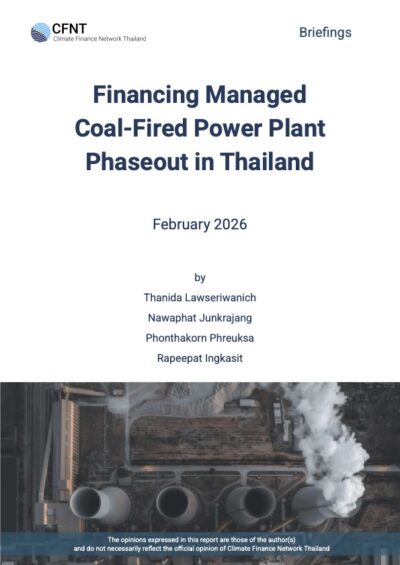
CFNT Report examines the feasibility of early phased out for a coal-fired power plant and proposes financial structuring options to support a just and practical transition for key stakeholders.
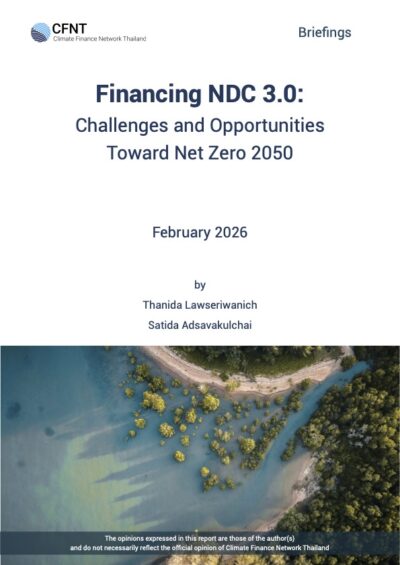
CFNT examines financing gaps between Thailand’s NDC 3.0 commitments and actual investment flows using CFNT’s Climate Finance Tracker, highlighting sectoral mismatches in priority technologies and opportunities to mobilize finance and accelerate Thailand’s path to net zero.
As the effects of global warming increasingly and adversely impact Thai society and the economy, Climate Finance Network Thailand (CFNT) and Fair Finance Thailand (FFT) propose 10 financial and finance-related policies to drive Thailand’s just transition by addressing 3 key problem areas.
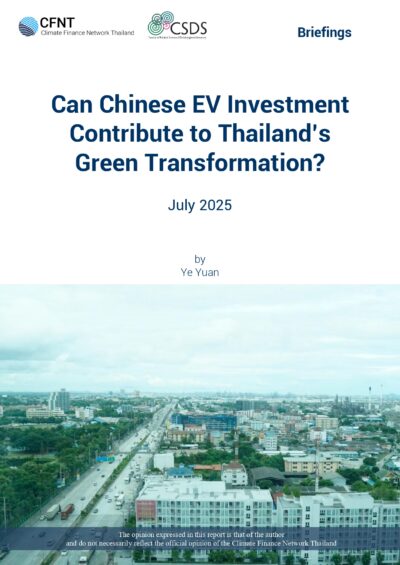
This report examines the governance structures and local implications of Chinese electric vehicle investment in Thailand. It intends to provide an evidence-based reference point for policymakers and stakeholders in both countries, for future research, analysis, and action towards a more inclusive, trusted, and equitable form of sustainable development.
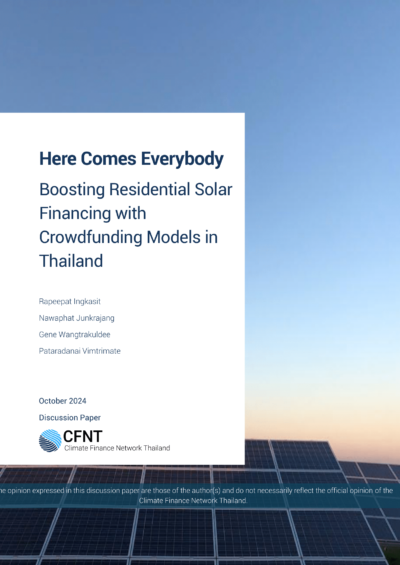
Thailand has abundant solar resources, but its utilization of solar energy falls short of its potential. This report explores crowdfunding as an alternative financing mechanism to bridge gaps in residential solar photovoltaic (PV) funding. We propose several financing models tailored to the Thai context, including Pay-As-You-Save (PAYS), which enables consumers to install solar PV systems […]
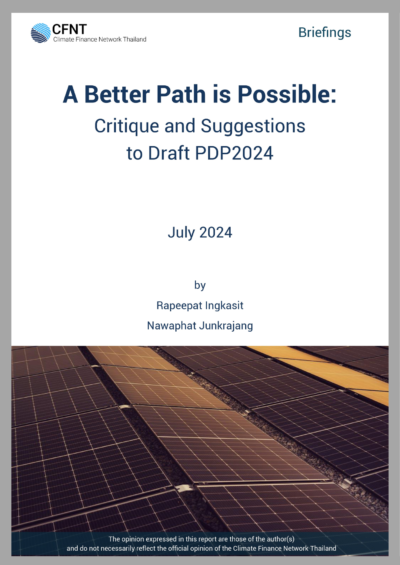
In this report, we critically analyze draft Power Development Plan 2024 (PDP2024), emphasizing its over-reliance on fossil fuels, particularly natural gas, and the high associated costs and risks. Despite Thailand’s commitment to achieving carbon neutrality by 2050, the plan prioritizes the development of new gas plants and unproven technologies such as Small Modular Reactors (SMRs) […]
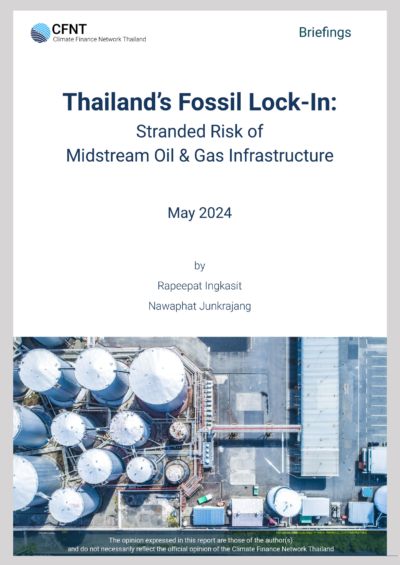
This report examines the financial risks of Thailand’s continued investments in midstream oil and gas infrastructure, including refineries and LNG terminals. As the world shifts towards net-zero emissions, these infrastructures face significant economic risks. The report details investment costs, with 189 billion THB for new oil refineries and 66 billion THB for new LNG terminal […]
This research aims to evaluate the financial impact of Thailand’s transition to clean energy focusing on the potential stranded asset values within the gas and coal powerplant industry. Employing the Discounted Cash Flow (DCF) methodology, our analysis encompasses three scenarios: (1) Base Case or Power Development Plan 2018 Revision 1, (2) Rapid Transformation, and (3) […]