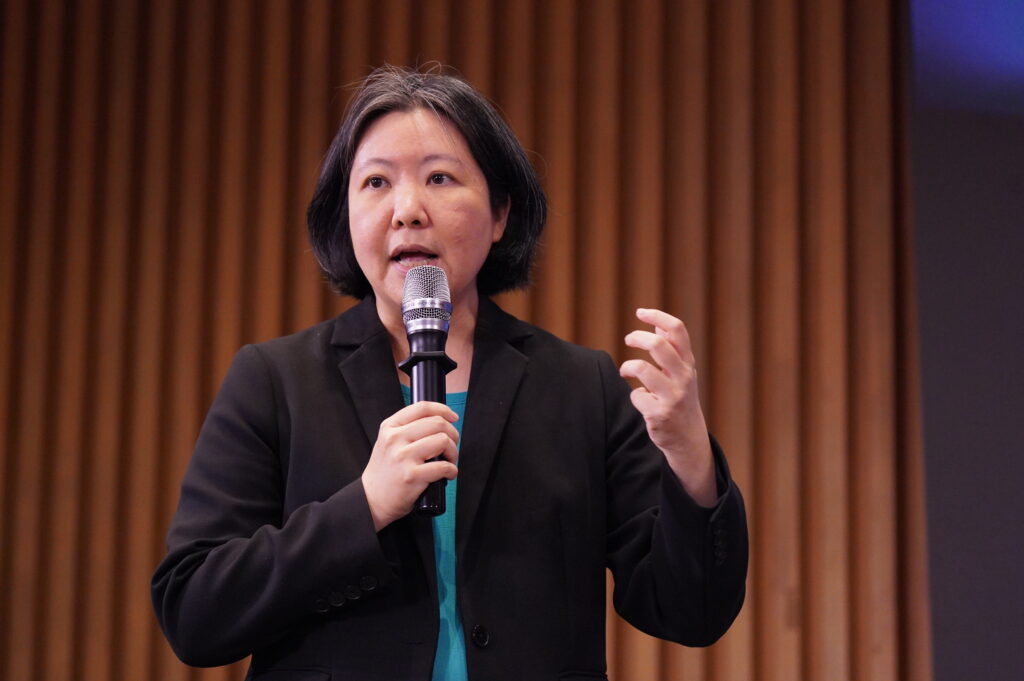
On 16 January 2026, Sarinee Achavanuntakul, Director of CFNT, participated as a speaker at the forum “#Election ’69: Thailand’s Energy Policies Toward Net Zero 2050,” organised by JustPow.
At the event, she presented the Energy Policy Recommendations White Paper from a financial perspective to 7 political parties contesting the upcoming election, with the aim of advancing a just and equitable energy transition in Thailand.
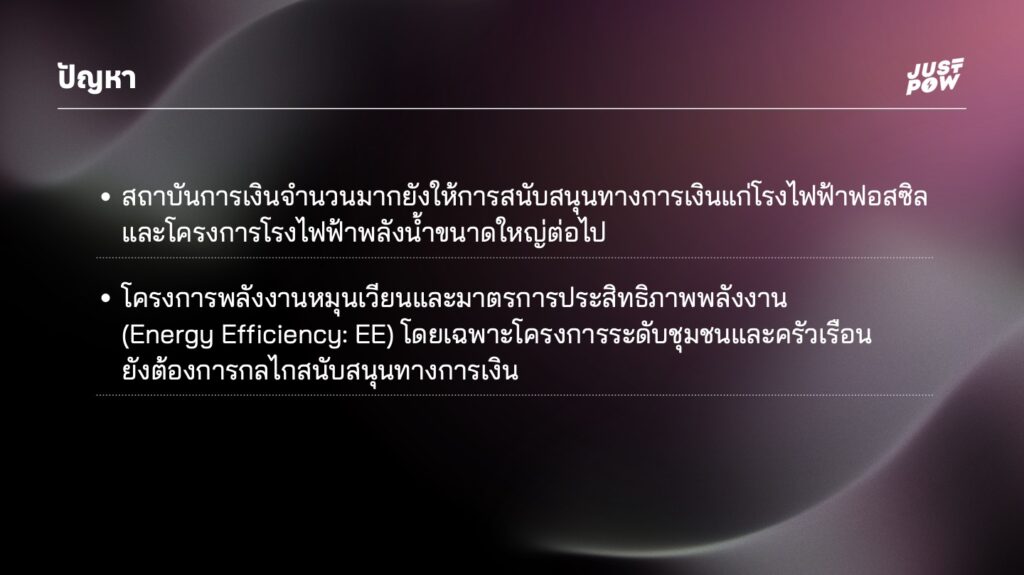
Two Key Challenges
The Director of CFNT highlighted two major challenges to achieving a just energy transition:
First, many financial institutions continue to provide funding to fossil fuel power plants and large-scale hydropower projects.
Second, renewable energy projects and energy efficiency measures—particularly at the household and community levels—still lack sufficient financial support mechanisms.
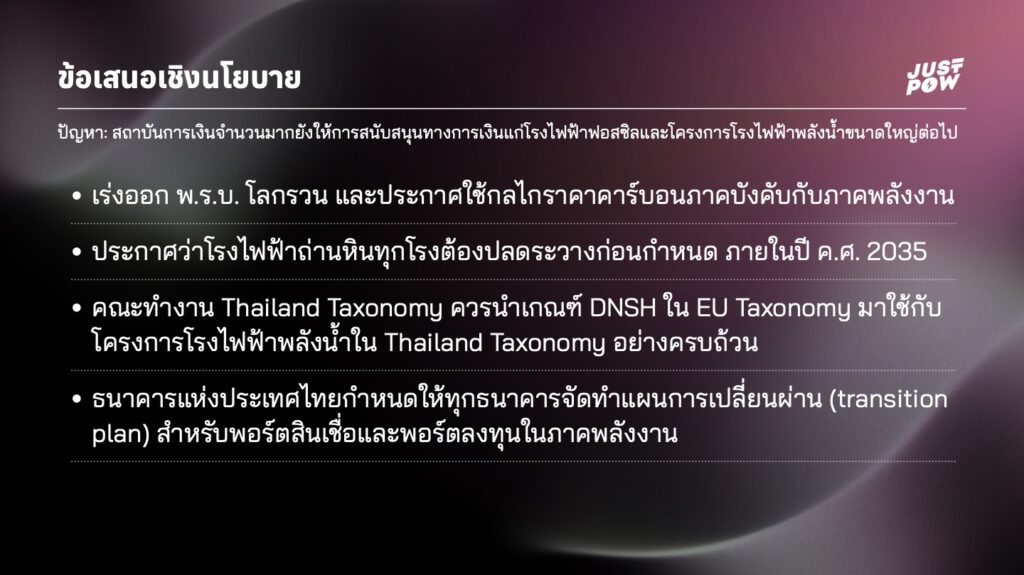
Seven Financial Policy Reccomendation to Address the Climate Crisis
To address these challenges, Sarinee proposed seven financial policy measures to tackle the climate crisis:
1. Fast-track the Climate Change Act and enforce mandatory carbon pricing in the energy sector.
The proposed legislation includes crucial financial instruments such as carbon pricing. However, there is no guarantee that these tools will be applied to the energy sector, which is the largest source of greenhouse gas emissions. The new government must therefore enforce mandatory carbon pricing in the energy sector to incentivise the transition toward a low-carbon economy.
2. Announce the phase-out of coal-fired power plants by 2035, in line with Thailand’s NDC 3.0.
The plan identifies early coal retirement as having the potential to reduce emissions by up to 6 million tonnes of CO₂ at the lowest cost—approximately USD 11 per tonne of CO₂.
Clear government commitment would enable early coal retirement to become feasible and allow the financial sector to design financial mechanisms to support this transition.
3. Fully apply the EU Taxonomy’s Do No Significant Harm (DNSH) criteria to hydropower projects.
Fair Finance Thailand argues that Thailand Taxonomy standards for hydropower projects are still insufficient and should fully incorporate DNSH principles, as follows:
3.1 Project developers must fully implement mitigation measures to minimise ecological impacts, including ensuring fish migration both upstream and downstream, minimising sediment disruption, mitigating short-term river flow fluctuations, and implementing wildlife habitat conservation measures.
3.2 Project developers must conduct comprehensive impact assessments on water resources, aquatic life, and vegetation, as well as fully assess cumulative impacts across the entire river basin.
4. The Bank of Thailand should require all banks to develop transition plans for their energy-related loan and investment portfolios.
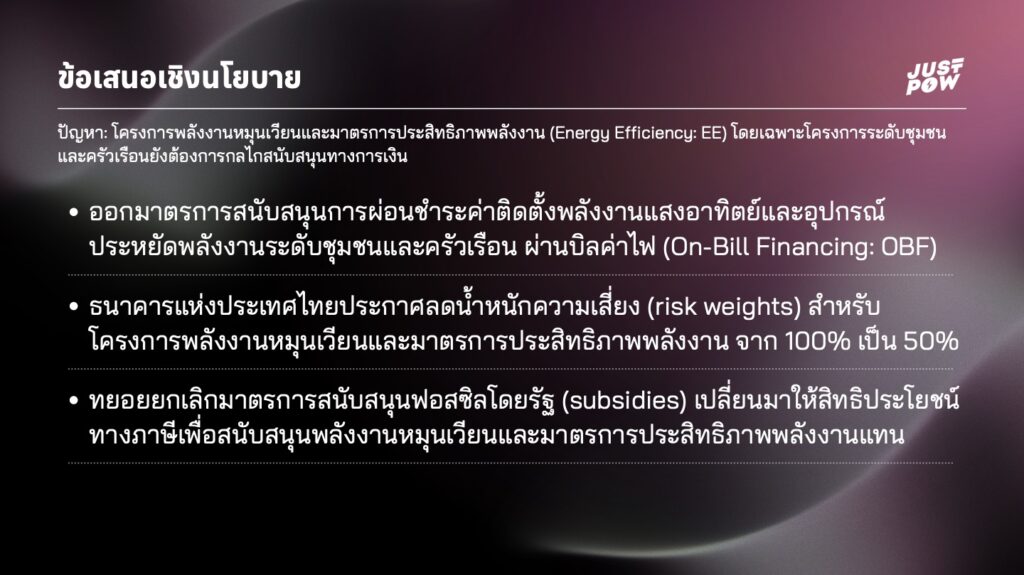
5. Introduce support measures for community- and household-level solar installations through On-Bill Financing (OBF)to reduce upfront costs and allow households to repay gradually through their electricity bills. (Further details available at: https://climatefinancethai.com/here-comes-everybody-boosting-residential-solar-financing-with-crowdfunding-models-in-thailand/)
6. The Bank of Thailand should reduce risk weights for renewable energy projects and energy efficiency measures from 100% to 50%, lowering project costs and enabling banks to extend more credit to renewable energy projects.
7. The government must gradually phase out fossil fuel subsidies and redirect support toward renewable energy projects and energy efficiency measures instead.
Other Policy Dimensions Presented at the Forum
In addition to financial policies, the event featured policy proposals across other dimensions from nine academics and experts:
- Power Purchase Agreements – Dr. Piti Eiamchamroonlarp, Faculty of Law, Chulalongkorn University
- Gas Power Plant Structure – Dr. Chalie Charoenlarpnopparut, SIIT, Thammasat University
- Coal Phase-Out – Dr. Pakpoom Lohavaritanond, Faculty of Law, Thammasat University
- Net Zero – Tara Buakamsri, Co-founder of Greenpeace Southeast Asia and Director of Climate Connectors
- Waste-to-Energy Power Plants – Supaporn Malailoy , Manager, Environmental Law Foundation (EnLAW)
- Direct PPA – Athit Wechakit Directors of the Thai Renewable Energy Association (RE100)
- Solar Energy – Teerapong Sanglarpcharoenkit, Co-Founder & Managing Director. RE Generation Thailand
- Grid Access – Chuenchom Sangarasri Greacen, Independent Researcher
- Financial Policy – Sarinee Achavanuntakul, Head of Research Fair Finance Thailand and Director of CFNT
Following the presentations, representatives from seven political parties shared their perspectives on which policy proposals they agreed or disagreed with, and the reasons behind their positions. Participating party representatives included:
- Korn Chatikavanij – Democrat Party
- Chattarin Chanhom – Pheu Thai Party
- Pariyes Angkurakitti – Thai Sang Thai Party
- Pongpol Yodmuangcharoen – Bhumjaithai Party
- Panurat Damrongthai – Thai Kao Mai Party
- Woraphop Viriyaroj – People’s Party
- Atavit Suwanpakdee – United Thai Nation Party
Subsequently, representatives from the political parties presented their policy positions and shared their views on the energy policy recommendations outlined in the White Paper, responding to each item listed in the document. Each representative provided different reasons to support their positions, whether in agreement or disagreement.
However, one proposal received unanimous support from all parties: the policy recommendation to streamline and reduce regulatory and permitting procedures for the installation and sale of electricity, thereby enabling the public to generate and sell solar power on their own.