
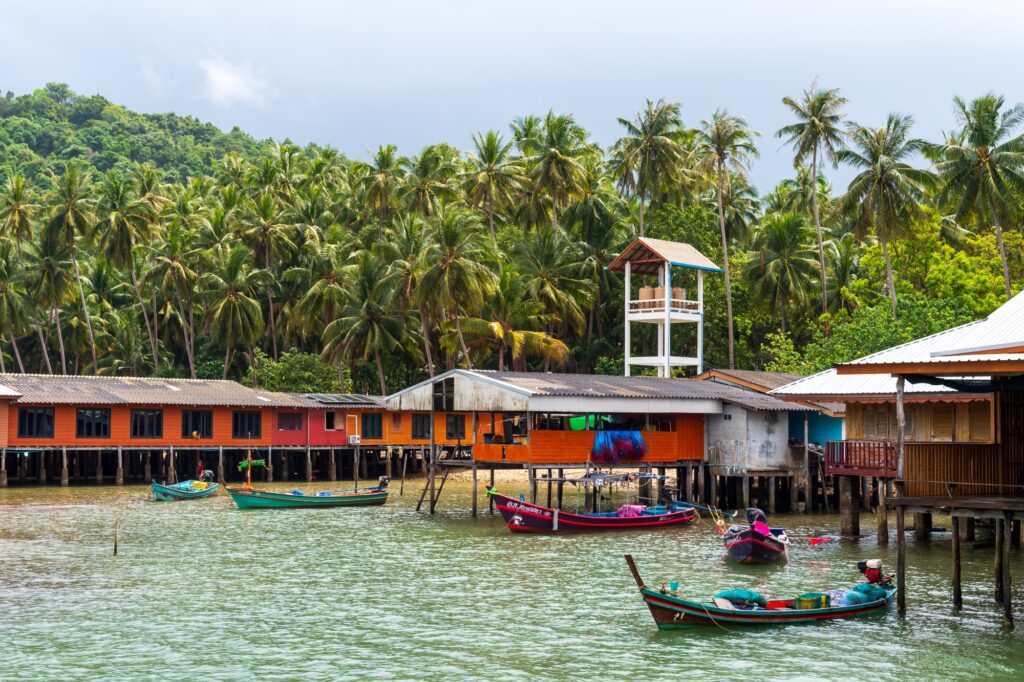
When Thai government discusses the Land Bridge, the focus dialogue has always been how the transshipment infrastructure can contribute to GDP and economy. This mega infrastructure —that will cost at least THB 1 trillion in a public-private partnership to get built, is part of planned Southern Economic Corridor —another special economic zone that Thai government is trying to develop in the southern region.
The idea of developing logistics route linking Gulf of Thailand and Andaman Sea is not novelty. Indeed, Thailand, or Siam back then, floated the idea of the Kra Isthmus Canal – a proposed open waterway between the two seas. This vision has never been panned out. Even the previous governments scaled down the infrastructure into land transport —with highways and rails to link two deep seaport, the Land Bridge project has been resisted by local communities, conservationists and even logistic experts.
Last week, Anutin government reportedly announced that it will halt the project after facing mounting public and communities’ resistance. The government pledges to re-evaluate the project based on geopolitical, environmental, and feasibility grounds. Yet is this the only stake Thailand is risking?
One thing is clear, environment and nature are perceived as vulnerable side. Indeed, natural resources can become a source of national income. Nature isn’t just environment — it’s an asset the state could cash in on.
In terms of Land Bridge project, Thailand is gambling a total of 14,349.88 rai of seagrass coverage, 218,000 rai of mangrove forest, and the biodiversity assets of Kra Isthmus for a megaproject whose revenue remains financially
Indeed, natural resources —mangrove forests and biodiversity are sovereign financial assets waiting to be valued and capitalized.
So, the questions that need to be asked is: What is natural capital and why should Thailand alternatively invest in nature?
What is natural capital and why should Thailand alternatively invest in nature?
In the pursuit of a low-carbon economy, ecosystems are not just environmental but also economic assets. Natural capital is the value of everything that comes from nature, including the co-benefits that may yet be economically captured, such as natural carbon sequestration, soil retention, and flooding mitigation.
Critically, as Thailand actively pursues OECD accession by 2028, the urgency lies in how the country can redirect financial flows into nature and reconsider economic decisions that are in line with the OECD’s advocacy on the responsibilities of government in enabling a nature-positive economic development framework.
At the deep seaport sites, Chumphon and Ranong represent quantifiable assets that could anchor financing mechanisms that directly link nature with climate adaptation. While nature financing seems new, public-private instruments, such as debt-for-nature swaps and blue carbon credits, already demonstrate the coexistence of nature-positive outcomes and financial returns, and Thailand is not walking this path alone.
Seychelles Sovereign Blue Bond can be a prime case study.
The Republic of Seychelles pioneered a debt-for-nature swap and converted public debt worth THB 718 million (USD 21.6 million; OANDA, June 2, 2026) through transactions facilitated by the Nature Conservancy into marine resources conservation. The debt conversion, in turn, established the Seychelles Conservation and Climate Adaptation Trust, which laid the institutional foundation for the issuance of the world’s first sovereign blue bond, raising THB 489 million from international public-private investors.
The bond proceeds were directed to scale finance for expanding Marine Protected Areas, the Seychelles Marine Spatial Plan, and Ecosystem-based Adaptation, in balancing GDP reliance on sustainable fisheries and tourism with the archipelago’s climate resilience.
Following Seychelles’ blueprint, Belize and Ecuador subsequently converted public debt worth THB 11.8 billion, and THB 49.8 billion, then directed proceeds toward Belize’s Caribbean Sea conservation and Ecuador’s contributions to Amazon rainforest protection through comparable debt-for-nature mechanisms.
Thailand may differ from these nations in many respects, but it shares a common dependence on natural capital as a foundation of economic well-being. Their experience demonstrates how governments can unlock private investment by reducing risk and establishing policy certainty, allowing nature to be managed as a long-term source of resilience, wealth and sustainable growth rather than a resource to be exhausted.
What are the next steps for Thailand’s Land Bridge proposal?
Redirecting financial flows toward nature-positive initiatives and divesting from mega grey infrastructure like the Land Bridge unlocks three gains for Thailand:
- Sustainable Tourism: Reshape conservation liabilities into biodiversity-enriched tourism experiences to unlock a growing sustainable tourism market that generates measurable financial returns from ecosystem services
- Climate Accountability: Avoid legal risk from advancing infrastructure with limited climate-integrated cost-benefit analysis, considering the International Court of Justice’s (ICJ) 2025 endorsement that NDCs constitute legally binding obligations under international law
- Blended Finance for Climate Adaptation Financing: Fostering public-private partnerships through debt-for-nature swaps to close adaptation financing gaps, as CFNT’s 2025 Climate Finance Tracker revealed that adaptation financing accounts for only 1% of the total climate finance landscape, while the World Bank estimates Thailand still needs a total additional investment of THB 3,420 billion over the next 25 years for adaptation alone.
On the upside, Thailand is not starting from scratch; DMCR’s COAST program and Blue Carbon mapping initiative, and ONEP’s National Biodiversity Action Plan provide the institutional foundation for nature financing to be deployed at scale. By adopting nature financing, Thailand can position itself as one of a few ASEAN nations to generate sovereign financial returns from the natural capital assets underpinning its tourism, fisheries, and blue economy.
By adopting nature financing, Thailand can position itself as one of a few ASEAN nations to generate sovereign financial returns from the natural capital assets underpinning its tourism, fisheries, and blue economy.
Amid intensifying climate hazards, GDP alone is an insufficient measure of Thailand’s economic growth, as it cannot capture the full value of ecosystem services in the real economy. The question before Thailand is not how much GDP the Land Bridge would contribute, but whether the projected revenue is worth the trade-off in the financial value of the natural capital it would directly imperil.
The halt on construction approvals gives the government a time-limited yet significant opportunity to assess natural capital valuation before the re-evaluation is finalized in August. This valuation may reframe the entire economic prosperity, revealing that Thailand’s greatest financial opportunity lies not in replacing these ecosystems with infrastructure, but in refinancing public debt into sovereign nature assets that already underpin its economy and climate resilience.
First Published on Bangkok Post