“Today, we can see that finance is flowing towards climate action. But the key question is no longer simply how much we invest. It is whether we are investing in the right areas, how effective those investments are, and whether anyone is being left behind.” Thanida Lawseriwanich, Head of Research, CFNT
On 23 July 2026, Climate Finance Network Thailand (CFNT) presented an overview of Thailand’s climate finance landscape, drawing on the Thailand Climate Finance Tracker 2026. The database tracks investments in climate mitigation and adaptation by the public sector, private sector, financial institutions and international organisations. The presentation took place at “2026 Climate Finance Tracker: Time to Walk the Talk,” at Dusit Thani Bangkok.
This year, CFNT’s research team moved beyond asking whether Thailand is investing enough to address climate change. It turned to an equally important question: how effective are Thailand’s climate investments? Without considering effectiveness, investing is like casting a net in shallow water. We may catch a few fish, but only after wasting time and effort—and perhaps tangling the net so badly that it tears.
How effectiveness of Thailand’s climate investment? This article summarises the findings presented in the Thailand Climate Finance Tracker 2026.
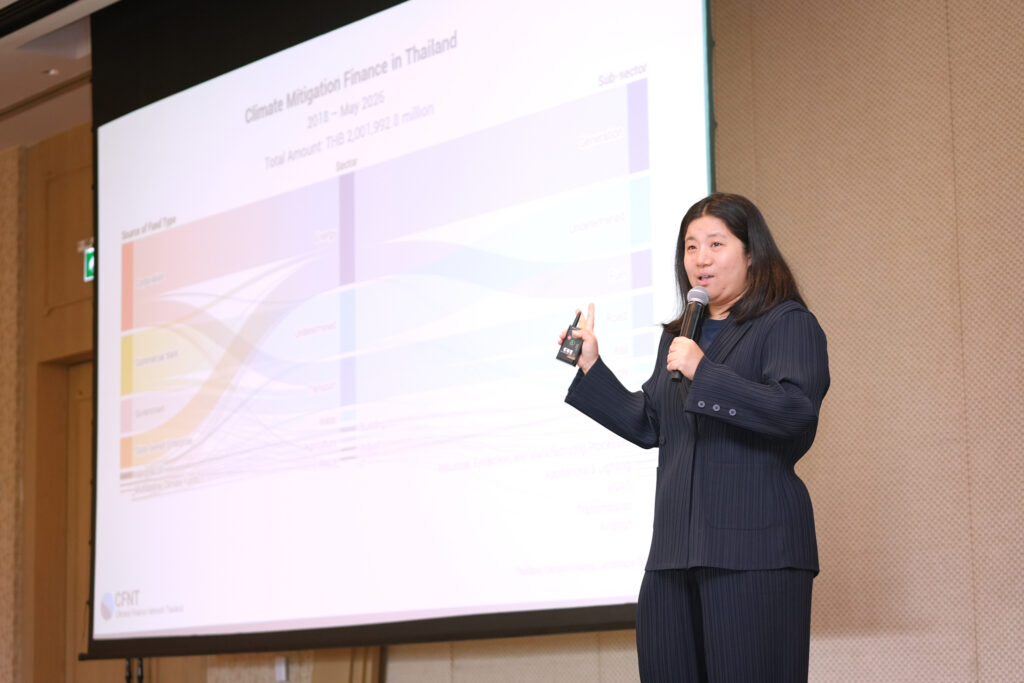
Thailand’s Climate Finance Landscape in 2026
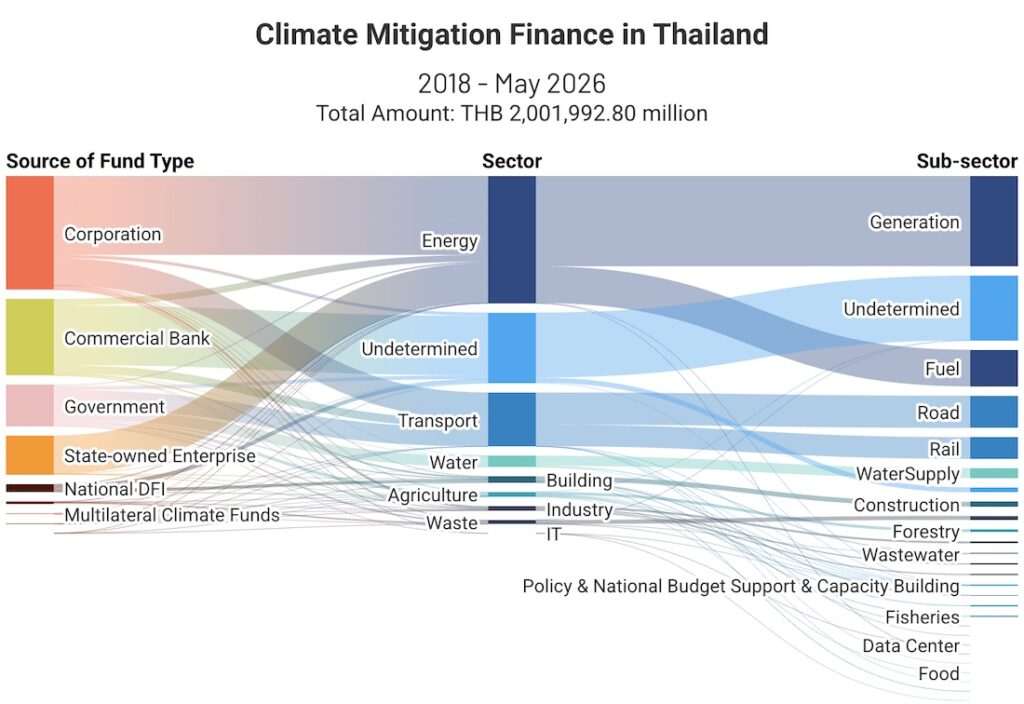
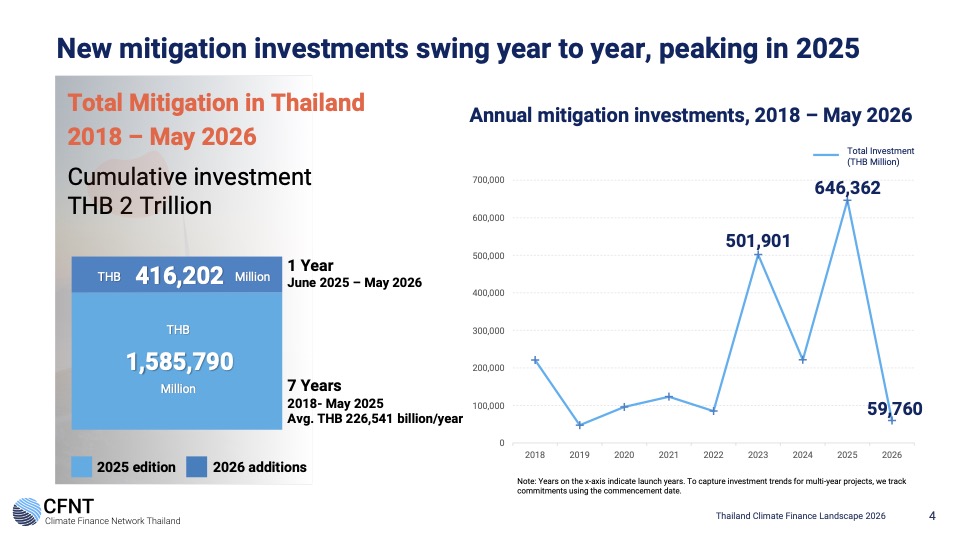
On climate mitigation, the study found that Thailand invested approximately THB 2 trillion between 2018 and May 2026—an increase of 26% compared with the 2025 database, which covered investments from 2018 to May 2025. The private sector and financial institutions remained the principal sources of mitigation finance, accounting for more than three-fifths of the country’s total mitigation investment.
Looking only at the most recent 12-month period, from June 2025 to May 2026, mitigation investment totalled THB 416.202 billion—nearly twice the annual average over the previous seven years. Thailand recorded its highest annual level of mitigation investment in 2025 since the Climate Finance Tracker began collecting data.
By economic sector, most mitigation finance remained concentrated in energy and transport. Together, the two sectors accounted for more than three-fifths of Thailand’s total mitigation investment. However, as much as one-quarter of all investment could not be classified by economic sector.
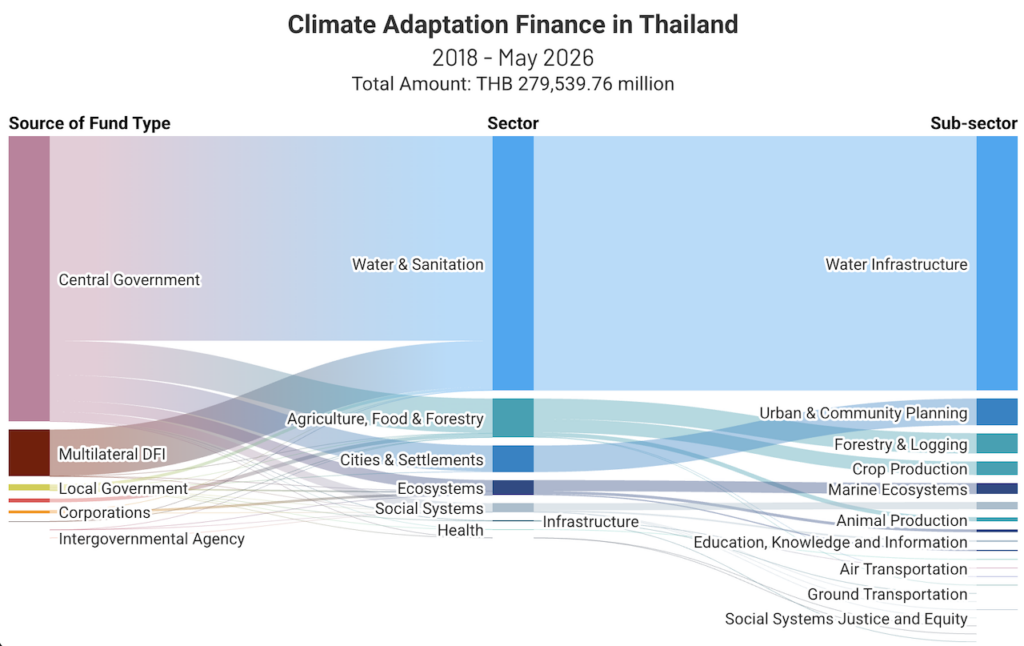
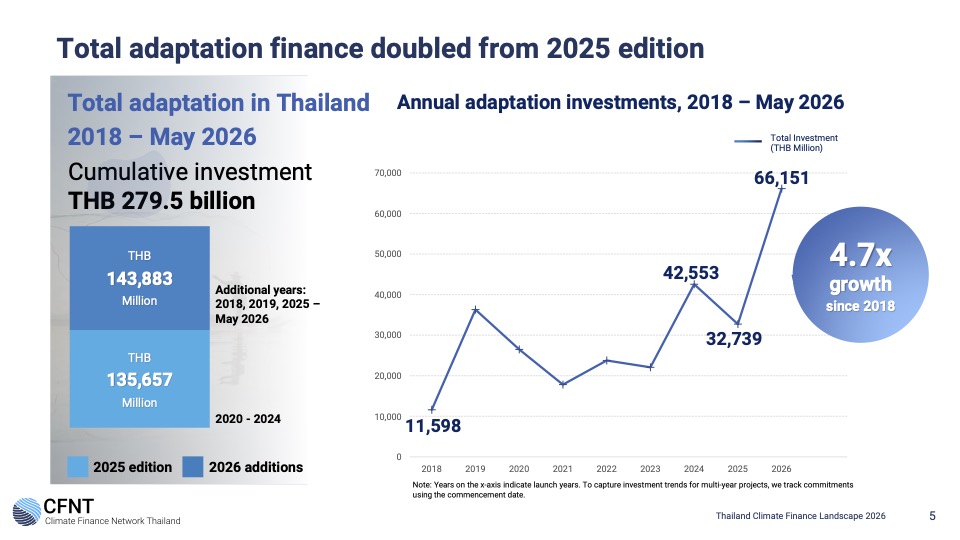
For Thailand’s climate adaptation finance landscape, based on data compiled jointly by CFNT and the Puey Ungphakorn Institute for Economic Research (PIER), Thailand invested approximately THB 279.5 billion between 2018 and May 2026. This was twice the amount recorded in the 2025 database, which covered the period from 2020 to 2024. The public sector remained the main source of adaptation finance, contributing more than four-fifths of the country’s total adaptation investment.
Adaptation investment in Thailand has risen steadily over the period covered by the Thailand Climate Finance Tracker. In 2026, it reached its highest recorded level—4.7 times the amount invested in 2018. Yet the Climate Risk Index 2024 ranked Thailand as the world’s 17th most climate-vulnerable country, while the Readiness Ranking placed it 123rd globally. These rankings suggest that, despite rising adaptation finance, current investment may still be insufficient and poorly matched to the scale of the challenges Thailand faces.
Across sectors, water management continued to receive the largest share of adaptation finance, accounting for three-quarters of all investment. Several other sectors, including public health, received less than 1% of the total.
Although the overall volume of climate finance is rising, a crucial question remains: are these investments well targeted, and how effective are they?
Challenges and Gaps in Thailand’s Climate Finance
CFNT’s analysis shows that Thailand’s climate investment still faces significant questions over effectiveness, alongside persistent financing and policy gaps. These challenges differ between mitigation and adaptation finance.
- Climate Mitigation Finance in Thailand
The Thailand Climate Finance Tracker 2026 identifies three major challenges for mitigation investment.
Challenge 1: Thailand has not give priority to abatement cost
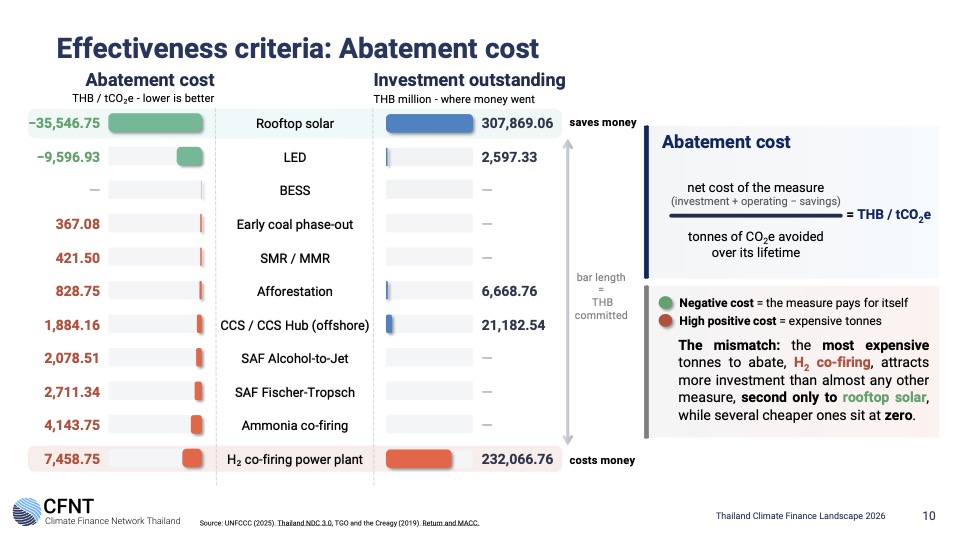
CFNT’s research team assessed investment value for money by calculating the cost of reducing one tonne of carbon dioxide equivalent, or the abatement cost. The analysis found that Thailand is taking rooftop solar more seriously—a positive step, as it is among the most cost-effective mitigation options. Yet the country is also placing considerable emphasis on costly, high-risk technologies such as small modular reactors (SMRs) and carbon capture and storage (CCS). Meanwhile, lower-cost and more mature options, including wind power and the early retirement of coal-fired power plants, receive less attention in Thailand’s power development planning.
Challenge 2: Thailand lacks investment in the infrastructure needed for the transition to a low-carbon economy
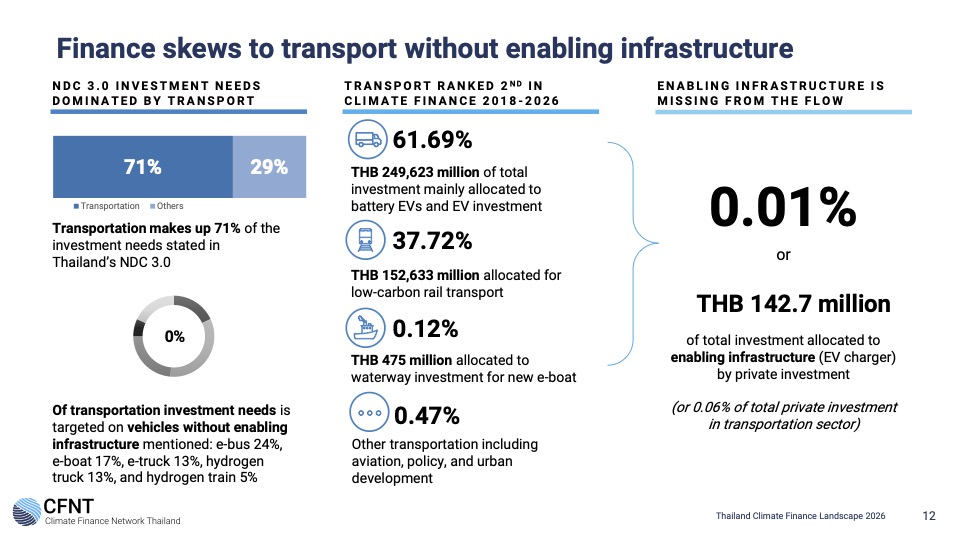
In the energy sector, more than 99% of investment—approximately THB 900 billion—went to renewable energy and fuel production. Investment in critical supporting infrastructure remained extremely limited: private-sector investment in grid development accounted for only 0.006% of total energy-sector investment.
The transport sector faces a similar challenge. Almost all investment was channelled towards low-carbon technologies, including electric public buses, electric boats and hydrogen trains. Yet supporting infrastructure received only a fraction of the funding. EV charging stations, for example, accounted for just 0.06% of total transport-sector investment.
“The Thailand Climate Finance Tracker shows that Thailand has mobilised substantial investment in climate mitigation across the energy and transport sectors. Yet investment in the infrastructure needed to support both sectors—such as EV charging stations and smart grids—accounts for less than 1% of total mitigation investment in these sectors.” Thanida Lawseriwanich, Head of Research, CFNT
Challenge 3: A large share of investment cannot be classified by economic sector
Unclassified investment accounted for one-quarter of the total, or approximately THB 499.408 billion. As a result, CFNT could not assess the effectiveness of this portion of the investment. However, financial institutions disclosed more investment data over the past year, a welcome sign for Thailand’s climate response.
- Climate Adaptation Finance in Thailand
The Thailand Climate Finance Tracker 2026 identifies two major challenges for adaptation investment.
Challenge 1: Investment does not adequately reach vulnerable groups
Although Thailand’s NDC 3.0 recognises the importance of vulnerable groups, including children, young people and women, it does not set out a clear implementation framework or dedicated budget allocations. At the same time, there remains a large financing gap in social systems, justice and equity. These areas received only THB 44 million out of the country’s total adaptation finance.
Challenge 2: Almost all investment continues to flow towards single-purpose grey infrastructure, particularly in water management
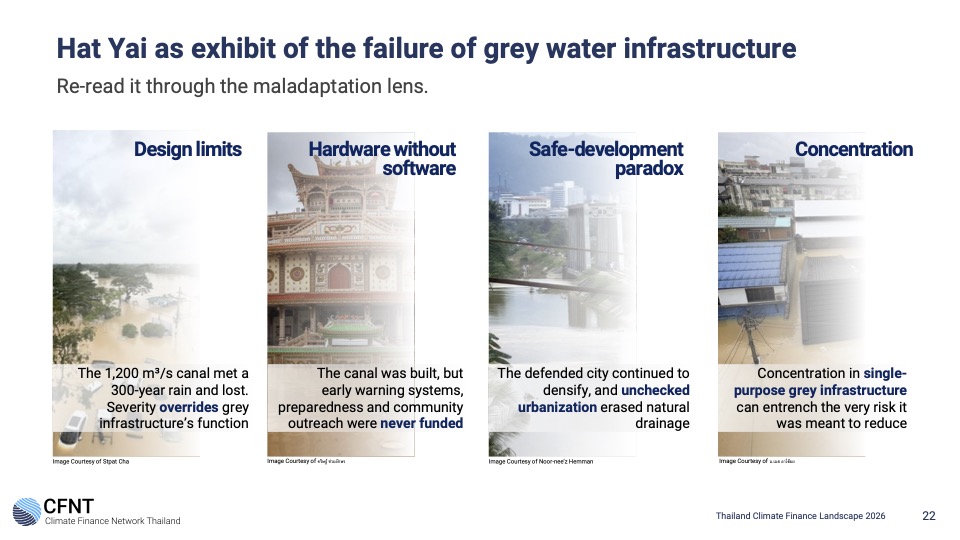
Such infrastructure may reduce risk in the short term, but it can also lead to maladaptation—actions that undermine long-term resilience to climate change. The flooding in Hat Yai, Songkhla, in late 2025 illustrates this risk. Not only did the infrastructure fail to perform its intended function, but the area also lacked a disaster warning system that could have enabled residents to evacuate in time.
“The flooding in Hat Yai in late 2025 highlights how relying solely on grey infrastructure can result in maladaptation, creating new risks instead of reducing existing ones.” Thanida Lawseriwanich, Head of Research, CFNT
How to Close Thailand’s Climate Finance Gaps
CFNT proposes a set of measures to improve the effectiveness of Thailand’s climate investment and close persistent financing and policy gaps.
- Closing the Mitigation Finance Gap
CFNT offers four recommendations to improve the effectiveness of Thailand’s climate mitigation investment.
Recommendation 1: Use abatement cost as a key criterion when prioritising public investment
Public investment decisions should consider the net cost of reducing one tonne of carbon dioxide equivalent. This would help ensure that public funds are directed towards the most cost-effective mitigation options, resist pressure from vested interests and prioritise critical infrastructure.
“In a world of limited resources, we must ensure that every investment delivers the greatest possible impact. Climate mitigation finance should therefore prioritise abatement cost and readily available solutions, such as solar power and the early retirement of coal-fired power plants, rather than high-cost and highly uncertain technologies, such as small modular nuclear reactors.” Thanida Lawseriwanich, Head of Research, CFNT
Recommendation 2: Introduce mandatory carbon pricing for the energy sector
Mandatory carbon pricing should be included in the Climate Change Act, which is currently under consideration by Parliament.
Recommendation 3: Encourage private investment by lowering borrowing costs through the banking sector
CFNT proposes that the Bank of Thailand reduce risk weights for investments in clean energy and energy efficiency.
Recommendation 4: Enable households to install rooftop solar through on-bill financing
Under an on-bill financing scheme, households would not have to pay the full upfront cost of installing rooftop solar panels. Instead, they could repay the cost gradually through the savings reflected in their monthly electricity bills from the Metropolitan Electricity Authority or Provincial Electricity Authority.

- Closing the Adaptation Finance Gap
For climate adaptation finance, CFNT worked with Pakkasem Tongchai, Water and Wetlands Programme Officer at the International Union for Conservation of Nature (IUCN), to produce the report Highlights from the 2026 Edition of Thailand Climate Finance Tracker: Introducing Maladaptation. The report sets out three recommendations to close financing gaps and reduce the long-term risk of investments leading to maladaptation.
Recommendation 1: Screen and rebalance water infrastructure
Thailand should increase investment in green infrastructure alongside improvements to existing infrastructure, while giving greater priority to disaster prevention and preparedness systems that strengthen community resilience.
Recommendation 2: Target vulnerable at community level
One example would be to develop heat-health maps for children, helping schools and families avoid outdoor activities on days when temperatures exceed safe thresholds.
“Although Thailand has a National Adaptation Plan, it still lacks clear implementation plans and dedicated financial allocations for vulnerable groups, particularly children and older persons.” Thanida Lawseriwanich, Head of Research, CFNT
Recommendation 3: Crowd in capital beyond public finance
The government should reduce or guarantee investment risks and use financial innovations—including microfinance and blended finance—to attract private-sector capital.
For more information on Thailand Climate Mitigation Finance 2026, visit:
https://www.climatefinancethai.com/tracker/mitigation
For more information on Thailand Climate Adaptation Finance 2026, visit:
https://www.climatefinancethai.com/tracker/adaptation