
Data from the Thailand Climate Finance Tracker 2026 show that Thailand’s investment in greenhouse gas mitigation and climate adaptation continues to rise. However, the next critical question is whether this enormous volume of investment is appropriate and reaching the right areas.
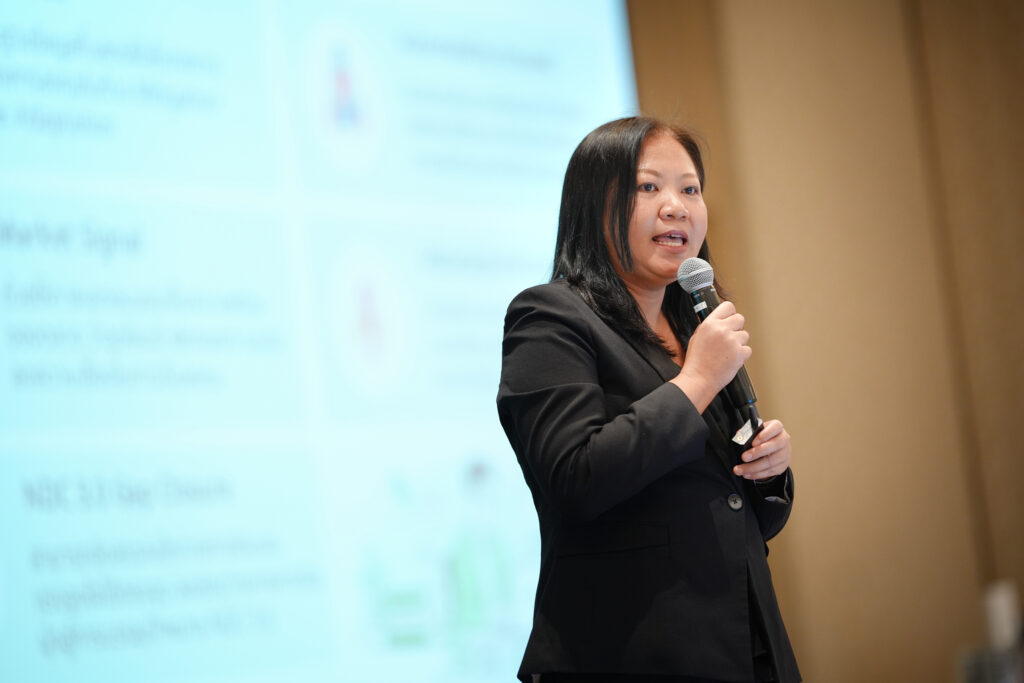
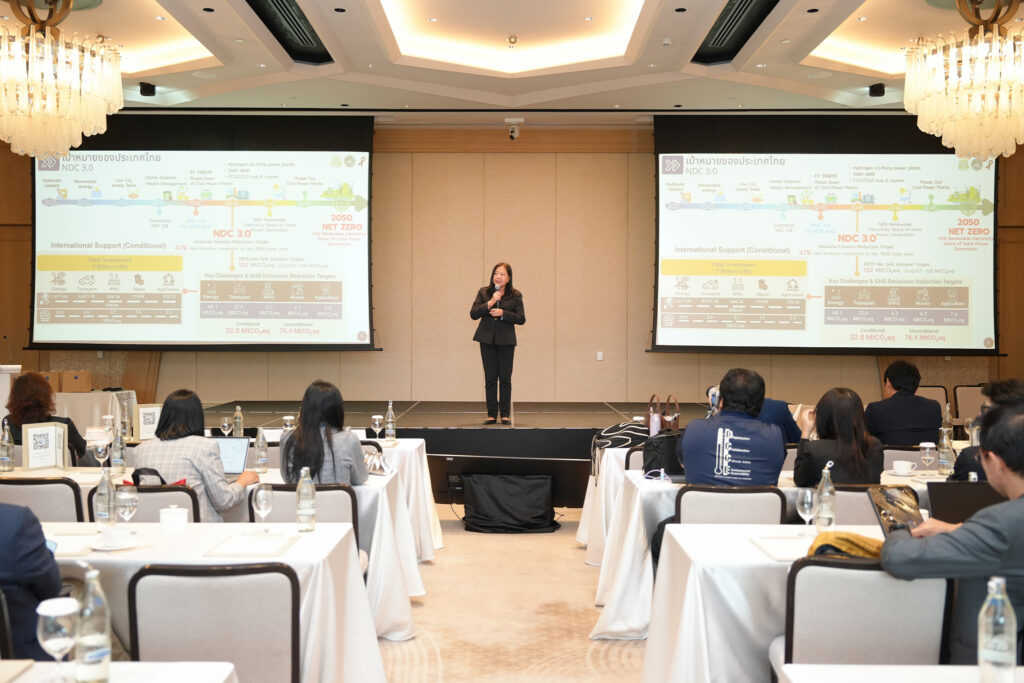
At the 2026 Climate Finance Tracker: Time to Walk the Talk event, held on 23 July, Climate Finance Network Thailand was honoured to welcome Dr. Napaporn Tangtinthai, Director of the Climate Finance and Investment Subdivision, Department of Climate Change and Environment (DCCE), Ministry of Natural Resources and Environment, to deliver a keynote address titled “Urgency of Effective Climate Investment”.
Her address reflected on the progress of government action in responding to climate change, the opportunities and challenges currently emerging, and the government’s recommendations to all sectors.
The climate-finance landscape in Thailand
Dr. Napaporn began by illustrating the intensifying impacts of climate change. According to the Climate Risk Index Report 2026, the world experienced a total of 9,700 disasters between 1995 and 2024, causing nearly USD 4.5 trillion in economic losses. This situation means that climate investment is not merely an environmental obligation, but a critical condition for long-term economic and trade prospects.
At present, in addition to NDC 3.0, which sets a target of net-zero greenhouse gas emissions by 2050, DCCE is developing a long-term strategy for submission to the Secretariat of the United Nations Framework Convention on Climate Change (UNFCCC) to guide Thailand’s response to climate change. DCCE is also awaiting the Ministry of Energy’s Power Development Plan (PDP) and is participating in drafting the 14th National Economic and Social Development Plan, so that both plans are aligned with the challenges arising from global climate and geopolitical change.
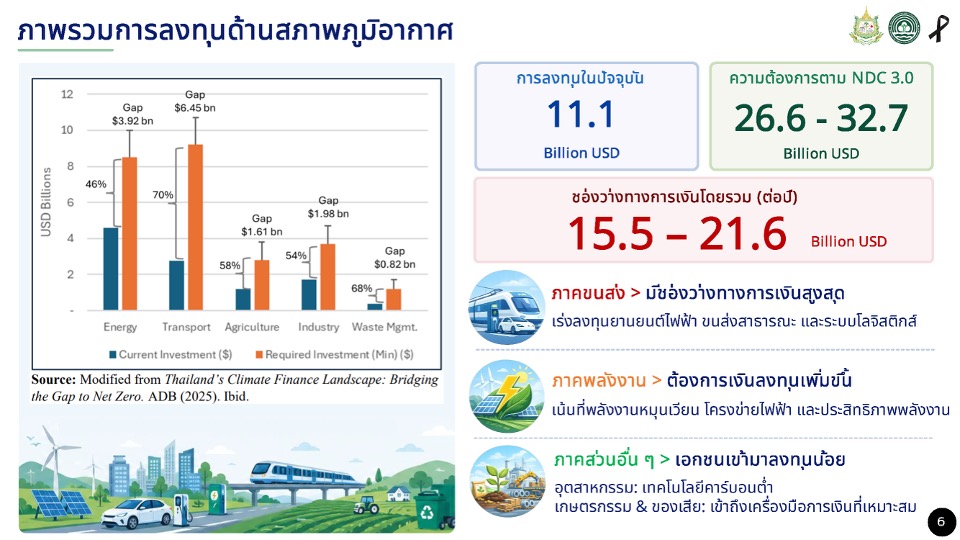
On greenhouse gas mitigation, a study conducted by DCCE in collaboration with the Asian Development Bank (ADB) found that Thailand currently invests approximately USD 11.1 billion per year in mitigation. However, the investment required to follow the NDC 3.0 pathway is estimated at USD 26.6-32.7 billion per year. This means that Thailand faces an annual mitigation-finance gap of approximately USD 15.5-21.6 billion. In other words, current investment covers only about one-third of the level projected in the report.
“Although the amount invested in greenhouse gas mitigation in Thailand continues to increase, current investment still accounts for only one-third of actual needs. There therefore remains a substantial financing gap, particularly for infrastructure investment in the energy sector, including transport.” Dr. Napaporn said.
The ADB report’s findings are consistent with those of the Thailand Climate Finance Tracker 2026. The energy and transport sectors receive the highest levels of investment, yet substantial gaps remain in critical infrastructure investment. The agriculture and waste-management sectors remain a particular concern because they receive relatively little private-sector investment, even though they require technology, financial instruments and knowledge that are aligned with local contexts.
“The economic sector of concern is solid-waste management, because it currently relies solely on investment from the government budget. We hope that the private sector will help fill this gap in the future. In addition to reducing the burden on the public budget, the private sector also has an opportunity to earn revenue from the sale of carbon credits in this area.” Dr. Napaporn said.
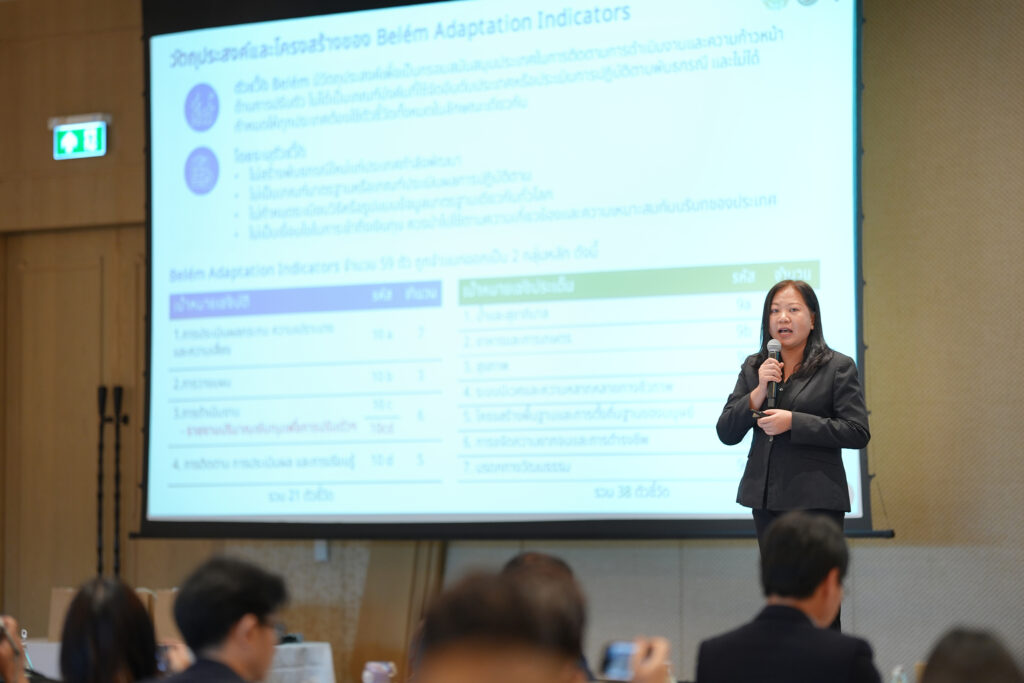
On climate adaptation, Dr. Napaporn noted that progress has accelerated. DCCE is implementing the outcomes of COP30 in Brazil, where a total of 59 key climate-adaptation indicators were established. These are divided into two groups: 21 indicators based on dimensional targets and 38 indicators based on thematic targets, covering water and sanitation; food and agriculture; health; ecosystems and biodiversity; infrastructure; livelihoods; and cultural heritage.
DCCE is discussing how to adapt these indicators for use at both national and project levels, in line with the conference outcomes. Under the National Adaptation Plan (NAP), the agency is also developing clearer sectoral NAP Action Plans for all six sectors. Thailand has already completed NAP Action Plans for public health and agriculture, and work is under way to complete the remaining sectors within this year. Dr. Napaporn noted that clearly defined indicators would enable more systematic monitoring and reporting of adaptation finance.
At the same time, DCCE is working with ADB on an additional study of the financing required for climate adaptation and for addressing climate-related loss and damage. It is also collaborating with GIZ to prepare capacity-building support on climate budgeting for the Bureau of the Budget. In addition, Thailand is seeking technical assistance and loans from the World Bank to develop its carbon market through the Low Carbon City and Carbon Market Development Project.
The Climate Change Act
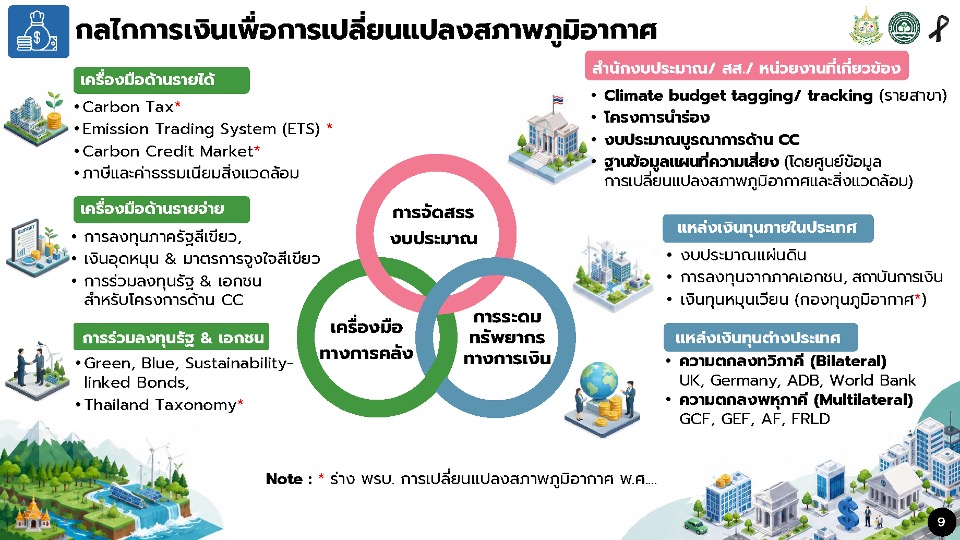
Dr. Napaporn provided an update on the draft Climate Change Act, commonly referred to as Thailand’s climate law. The draft is currently under consideration by the Council of State. It is expected that in 2027 the legislation will pass consideration by the House of Representatives and the Cabinet before being promulgated for the first time. Following its enactment, Thailand will establish an organisational greenhouse gas database through the Carbon Footprint for Organization (CFO) framework, before moving ahead with an Emissions Trading System (ETS). The ETS will serve as the core financing mechanism for establishing a Climate Fund and implementing the climate law.
The financial mechanisms under the climate law are divided into three main components:
Public budget allocations
Fiscal instruments, such as a carbon tax and an Emissions Trading System
Mobilisation of financial resources, such as a Climate Fund and international financial support
Dr. Napaporn highlighted one important financial mechanism: public-private co-investment through a Sustainability-Linked Bond (SLB). The first bond used greenhouse gas reduction and the number of new registrations of zero-emission vehicles as its performance indicators. According to data from the Public Debt Management Office, its total outstanding value stood at THB 230.139 billion in June 2026, representing a high level of success. For the second fundraising round, the aim is therefore to set more comprehensive indicators covering greenhouse gas mitigation, climate adaptation and biodiversity.
“The second Sustainability-Linked Bond will set indicators covering greenhouse gas mitigation, climate adaptation and biodiversity, so that the proceeds can be used to finance climate action and put pressure on the government to deliver on its climate-change targets.” Dr. Napaporn said
Challenges in accessing international finance
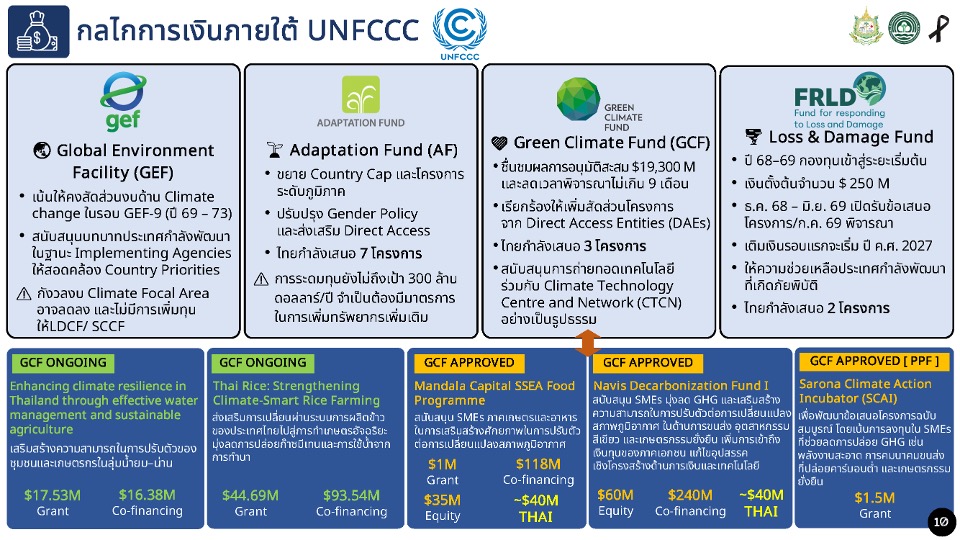
Dr. Napaporn noted that between 2023 and 2027, Thailand was able to attract more than USD 3.5 billion through international cooperation mechanisms. However, there is both good news and bad news in this area.
- The Global Environment Facility (GEF) has reduced its funding allocation for Thailand
Dr. Napaporn stated that under the eighth GEF funding cycle (2021-2025), Thailand received nearly USD 20 million. However, the allocation fell in the ninth funding cycle (2026-2030), with Thailand’s allocation reduced to only USD 1.3 million.
- Green Climate Fund (GCF)
Thailand is implementing two GCF projects: Enchancing Climate Resilience in Thailand through Effectiveness Water Management and Sustainable Agriculture, and Thai Rice: Strengthening Climate-Rice Smart Farming. Their combined value, including co-financing with Thai banks such as Bank of Ayudhya Public Company Limited and the Bank for Agriculture and Agricultural Cooperatives, includes approximately USD 172 million in grant funding.
In addition, further projects were approved in 2025-2026. These include the Mandala Capital SSEA Food Programe, which will support SMEs in the agriculture and food sectors to strengthen their capacity to adapt to climate change; Navis Decarbonization Fund I, which also concerns greenhouse gas mitigation by SMEs, the energy transition and biomass fuels; and the Sarona Climate Action Incubator (SCAI), which provides approximately USD 1.5 million to develop full project proposals that support SMEs in reducing greenhouse gas emissions through areas such as clean energy and sustainable agriculture. It also supports the waste-management sector through a municipal-waste treatment project using black soldier fly larvae. Through all three projects, Thailand will receive support in the form of equity and co-investment from international funds.
However, Dr. Napaporn noted that this stream of GCF finance is encountering increasing constraints because a major contributor, the United States, has withdrawn from the UNFCCC, while the United Kingdom has significantly reduced its financial support.
- Adaptation Fund
Thailand is currently proposing seven projects for financial support from the Adaptation Fund, covering national projects, regional projects and innovation projects.
- Fund for Responding to Loss and Damage (FRLD)
The final source of finance under DCCE’s responsibility is the Fund for Responding to Loss and Damage. Developing countries such as Thailand may access a share of approximately USD 125 million from the fund’s total of USD 250 million. Thailand has already submitted two funding proposals. Dr. Napaporn added that this fund remains very new, as it was only recently established at COP30.
- An NGO independently applies to become an Accredited Entity for the forestry sector
Dr. Napaporn added that a regional NGO working in the forestry sector, including in Thailand, has passed the first round of document submission to seek direct access to funding. The proposed work concerns carbon credits and carbon sinks in the forestry sector. Dr. Napaporn described this as very good news for Thailand’s response to climate change.
Thailand’s next steps
“The time has come for investment in responding to climate change to be pursued with strength and seriousness. We must use the Thailand Climate Finance Tracker as a compass for investment and as a key to unlocking private-sector investment.” Dr. Napaporn said.
Dr. Napaporn concluded with four recommendations for advancing climate finance:
First, use the Thailand Climate Finance Tracker developed by CFNT as a compass and a key to unlocking private-sector investment.
Second, align financial-sector investment portfolios with the targets of NDC 3.0 and the Thailand Taxonomy.
Third, accelerate investment in climate adaptation through private-sector investment and international finance in order to reduce the burden on the public budget.
Fourth, design green financial products that meet the needs of small-scale entrepreneurs.
Throughout the 2026 Climate Finance Tracker: Time to Walk the Talk event, all panellists expressed hope that Thailand could work together to establish a firm footing in the face of climate challenges that will intensify in the future. They shared the belief that, as long as this cooperation continues, Thailand will be better prepared for the challenges of climate change across the economy, trade and people’s quality of life.
For more information on Thailand Climate Mitigation Finance 2026, visit: https://www.climatefinancethai.com/tracker/mitigation
For more information on Thailand Climate Adaptation Finance 2026, visit: https://www.climatefinancethai.com/tracker/adaptation