
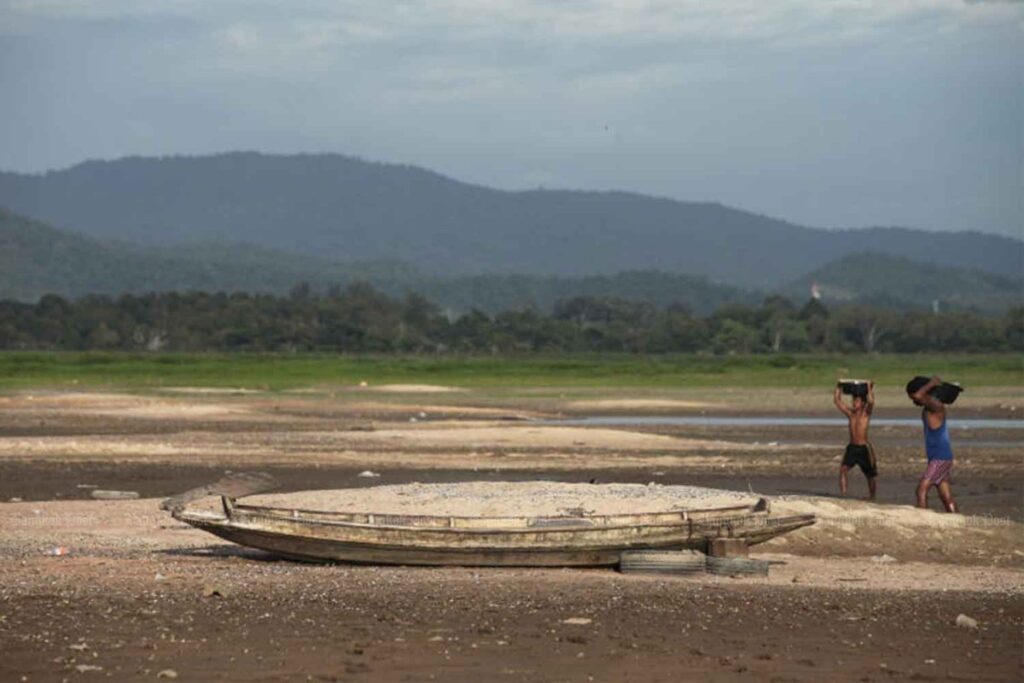
El Nino has officially formed, and forecasters at NOAA and the World Meteorological Organization warn it could strengthen into what some are already calling a super El Nino, potentially one of the most intense on record, peaking late this year and carrying severe heat and drought into 2027.
For Thailand’s farmers, this is not another distant climate headline. It could mean perfect strom for a sector that still employs around 11 to 12 million people: a season of drought and extream heat amid volatile crop prices, rising production cost and tougher regional competition.
This April offered a glimpse of what that means. A summer storm tore through the volcanic-soil durian orchards of Si Sa Ket province. Fruit that had been nurtured for 70 to 110 days, just weeks away from harvest, was ripped from the trees overnight. Around 390 tonnes were lost, worth an estimated 39 million baht. One grower described investing 300,000 to 400,000 baht in his orchard, only to watch it vanish in a single night.
Research using four decades of Thai provincial data projects that climate change will depress per-capita incomes for the majority of the Thai population, with the damage concentrated in agriculture.
The question remains, what stands between a farming family, climate change and financial ruin?
A policy that pays when the rain fails
Less than most people assume. Thailand does have an agricultural safety net, on paper. Under the Finance Ministry’s disaster relief regulations, a durian grower whose trees are destroyed receives roughly 4,048 baht per rai, for orchards that can generate hundreds of thousands of baht per rai in revenue.
A state-subsidised rice insurance scheme covers the main crop, while weather-index has been tested in Thailand since 2010. But the coverage is narrow, the sums are small, and conventional claims require officials to survey damage plot by plot, so payouts take months while debts to the bank wait for no one.
Zoom out and the picture grows starker. Natural disasters caused at least 76 billion dollars in economic losses across Asia-Pacific in 2025, and insurance covered only about 10 percent of it. Thai farmers, in effect, shoulder the full weight of climate risk on their own backs, despite having contributed almost nothing to causing it.
One solution the world is increasingly turning to, and for which Thailand is better prepared than most people realise, is parametric insurance.
The principle is almost disarmingly simple. Instead of waiting for an assessor to walk through the fields and tally the damage, a parametric policy pays out automatically the moment a pre-agreed trigger is met. The trigger can take many forms. Rainfall falling below a certain level, wind speeds exceeding an agreed threshold, or the average harvest district falling short of its historical norm.
A parametric policy pays out automatically the moment a pre-agreed trigger is met. The trigger can take many forms. Rainfall falling below a certain level, wind speeds exceeding an agreed threshold, or the average harvest district falling short of its historical norm.
India’s already uses area-yield disigns at national scale, reaching tens of millions of farmers. Mexico has gone a step further, working with UNDP and reinsurers, using sovereign parametric insurance to protect smallholder farmers, with payouts flowing directly to affected producers. The state buys the umbrella, and the farmer stays dry. If the rain fails, the money arrives. No paperwork. No disputes. No months of waiting.
East Africa provides another example. A Kenyan scheme that began as a modest pilot has grown into ACRE Africa and insured more than three million farmers across the continent, with premiums paid and payouts received through mobile phones.
The deeper value goes beyond the payouts themselves. A 2025 meta-analysis aggregating eight randomised experiments found that access to index insurance raises farmers’ productive investment by 8 to 16 percent, because farmers who know a failed season will not wipe them out plant and fertilise with more confidence.
Thailand is not starting from zero. The Office of the Insurance Commission already has a regulatory sandbox for innovative insurance products and last year formed a joint committee with the Office of Agricultural Economics to bring technology into agricultural insurance. The data infrastructure, from weather stations and satellite feeds to the PromptPay system that already delivers state farm relief straight to ID-linked bank accounts, is more advanced than in many countries where parametric insurance succeeded at scale.
The pieces are largely on the table. The question is how to put them together before the next major drought.
What Thailand should build before the drought hits
So here is a concrete proposal.
Ahead of the El Nino peak, Thailand should launch a rainfall-deficit parametric product for rice in the provinces most exposed to drought, using satellite rainfall data cross-checked against ground stations, with payouts delivered through PromptPay within days of a trigger event.
Rainfall is the right first index precisely because drought is the risk now bearing down on us, and because it is transparent enough for a farmer to verify on a phone. As district-level yield data matures, the scheme should evolve toward area-yield coverage on the Indian model, which tracks what farmers actually care about, the harvest itself.
The money is less of an obstacle than it appears. Thailand already subsidises rice insurance premiums every year through the agricultural bank. Redirecting part of that budget from slow conventional insurance toward parametric coverage buys faster protection with the same baht.
For catastrophic years, the top layer of risk should be passed to international reinsurers, and Thailand should put regional risk pooling.
Thailand should launch a rainfall-deficit parametric product for rice in the provinces most exposed to drought, using satellite rainfall data cross-checked against ground stations, with payouts delivered through PromptPay within days of a trigger event.
Our neighbours are ahead of us here. When Typhoon Yagi struck in 2024, the same storm that drowned 3.5 million rai of Thai farmland, Laos received a three million dollar insurance payout within days through SEADRIF, the ASEAN disaster risk facility, and this May the facility launched Southeast Asia’s first anticipatory drought insurance, in Laos, that pays out before the worst of a drought arrives.
Thailand, a founding voice in ASEAN, is not yet using this machinery for its farmers. A super El Nino year is the right time to start.
The question we should be asking
The real question is not whether parametric insurance is perfect. It is whether the current system, one that leaves 12 million farm workers to carry climate risk alone with a few thousand baht per rai as their last line of defence, is truly the better alternative.
El Niño will eventually pass. The underlying warming trend will not. Floods, droughts, storms and heat will keep testing an agricultural economy in which too much climate risk still sits on individual households.
The technology exists. The pilots date back fifteen years, and their lessons have been learned. The regulatory machinery is in place. What is missing is the decision to open the umbrella before the sky turns.
