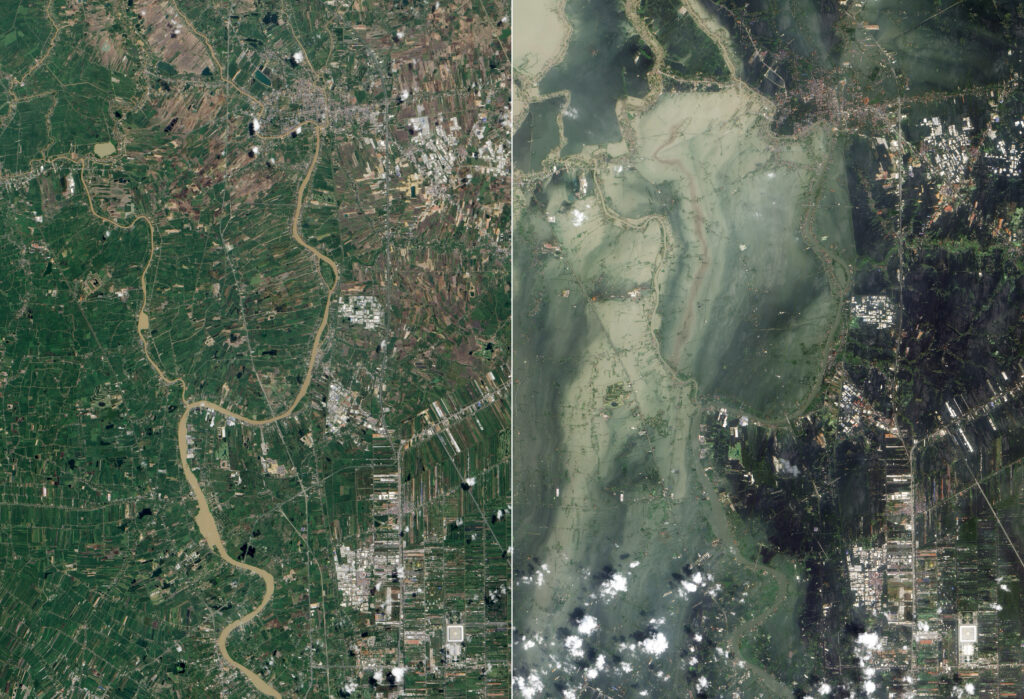
Heavy rainfall and floods continue to plague Thailand’s cities. A trifecta of heavier-than-usual rainfall exacerbated by the La Niña weather pattern, unsafe overcapacities at major dams, and unusually high sea tides is a stern reminder of how vulnerable Thailand’s urban centres are amid the world’s changing climate.
There have been improvements in disaster preparedness and relief efforts when compared to the 2011 mega floods, but lives have nevertheless been disrupted. It is also happening throughout the country, in the capital region of the Bangkok metropolitan area and various other provinces, making disaster management even more challenging.
While government efforts to relieve the pressure are laudable, like the approval of a 6.1-billion-baht relief package, such efforts are more reactionary due to limited national and local government resources to fund more effective prevention efforts. Even if more funds can be allocated, climate change is raising questions about whether previous types of activities will be enough in the long term.
There needs to be an ecosystem shift from looking at addressing disasters from “disaster prevention” to “climate adaptation”. This is especially since water management is just one issue caused by climate change, which Thailand’s cities are facing, excluding worsening air quality, land subsidence, and heat stress, among others.
However, moving that needle requires more action beyond the public sector alone.
Finding the Way Forward
According to research by the Puey Ungphakorn Institute for Economic Research (PIER), based on International Monetary Fund (IMF) estimates, Thailand will need 192 billion baht annually in adaptation finance for public and private infrastructure.
But getting there seems a monumental task. According to the Thailand Climate Finance Tracker by Climate Finance Network Thailand (CFNT), only 148 billion baht has been channelled to climate adaptation financing between 2020 and 2024, with the majority of funding coming from the national government. At the local level, the problem is even more stark, with local governments only receiving 1% of that total government support at 1.46 billion baht.
Thailand need 192 billion baht annually in adaptation finance, but according to the Thailand Climate Finance Tracker by CFNT, only 148 billion baht has been channelled to climate adaptation financing between 2020 and 2024
We’ve entered a critical period. Given that climate-related disasters will stymie the growth prospects of Thailand and similar developing economies across the greater region, CFNT brought together climate finance experts from the World Bank, the Singapore Green Finance Centre, and the Beijing-based Greenovation Hub to deliberate on how we can mobilise more climate financing during the inaugural Bangkok Climate Action Week, jointly organised by the Just Transitions Incubator (JUTI) and the Bangkok Metropolitan Administration (BMA).
Here are some of my key takeaways about some of the levers we can use to get there:
Leveraging New Capital Sources
According to the World Bank, developed countries by 2030 will need three times more climate finance to meet their adaptation and mitigation needs. To scale up the funding required, a key strategy would be to further Green Finance, particularly by strengthening the capacity of financial institutions to identify, manage, and assess climate-related risks. Simultaneously, funds must flow towards projects, technologies, and innovations that engender climate-positive outcomes.
To enhance such measures, new sources of capital must be unlocked. Alongside domestic and international investment sources, more innovative financial instruments such as carbon credits and blended finance (referring to the strategic use of development finance for the mobilisation of additional finance towards sustainable development, according to the OECD).
Understanding Local Nuances
The Climate Policy Initiative estimates that Asia’s needs US$431 billion in climate adaptation finance, but only US$34 billion, or less than 10%, has been invested. While significantly more funds are required, it must be emphasised that the adaptation needs of each country in Asia, as well as their urban centres, are different.
The Climate Policy Initiative estimates that Asia’s needs US$431 billion in climate adaptation finance, but only US$34 billion, or less than 10%, has been invested.
As such, adaptation policies are inherently local. For example, Bangkok doesn’t face exactly the same climate challenges as Kuala Lumpur, Singapore, or Jakarta. This means that climate adaptation strategies, along with the supporting financial mechanisms and knowledge systems, must be locally driven — particularly by the local communities that directly experience their respective climate change impacts.
Closer International Cooperation
Especially in developing countries, green finance policies and related taxonomies remain nascent. Although sustainable finance taxonomies across Asean and Thailand have recently taken effect and signify important initial steps, they are still not as rigorous when compared to more advanced economic regions such as the EU, and hence local governments face challenges in their effective implementation.
It is here where international cooperation — particularly via the South-South dynamic — in advancing climate adaptation projects can support this nascent drive. Such collaborative efforts, especially when between local governments, may include direct financial support, technical assistance, such as early warning systems design, and knowledge-sharing, like tools to assess physical climate risks.
We’re All in This Together
Although Thailand and its urban centres are facing the brunt of climate change, the adverse effects, while inherently local, are not isolated to just one place.
It’s a race against time for many cities across the developing world, in Asia and beyond. But it is through the shared experiences — while understanding each other’s nuances — that we can improve the cooperation of climate adaptation policy best practices. When supplemented by continued engagements between diverse key stakeholders, institutions, and governments, as exemplified by Bangkok Climate Action Week, this would create a more conducive environment for financial ecosystems to realign their strategies to reduce the widening climate finance gap.
First Published on Bangkok Post