
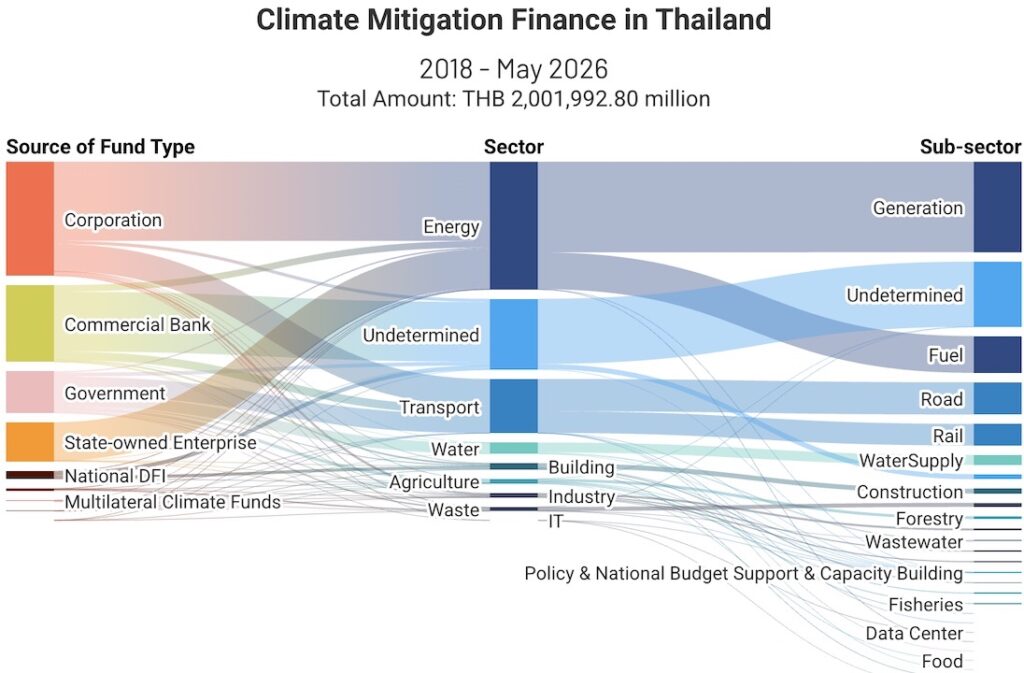
Data from the Thailand Climate Finance Tracker 2026 show that investment in climate mitigation in Thailand has surpassed THB 2 trillion. Yet the sheer scale of investment does not necessarily mean that the money is being used effectively or directed towards the areas where it is most needed.
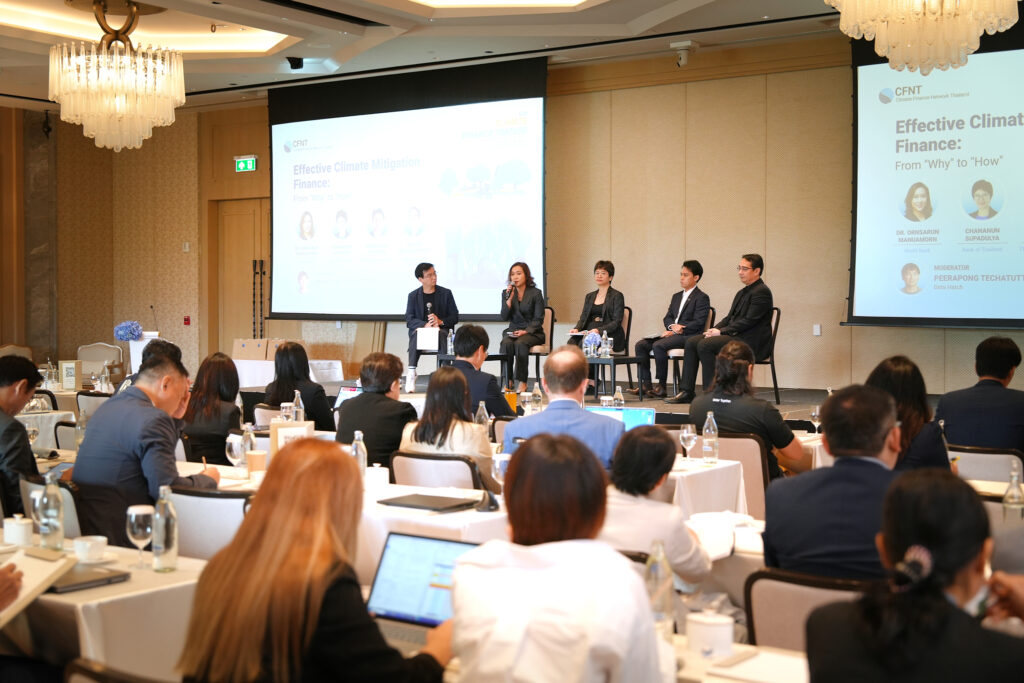
At the 2026 Climate Finance Tracker: Time to Walk the Talk, held on 23 July 2026, Climate Finance Network Thailand (CFNT) convened the panel discussion “Effective Climate Mitigation Finance: From ‘Why’ to ‘How’.” The speakers were:
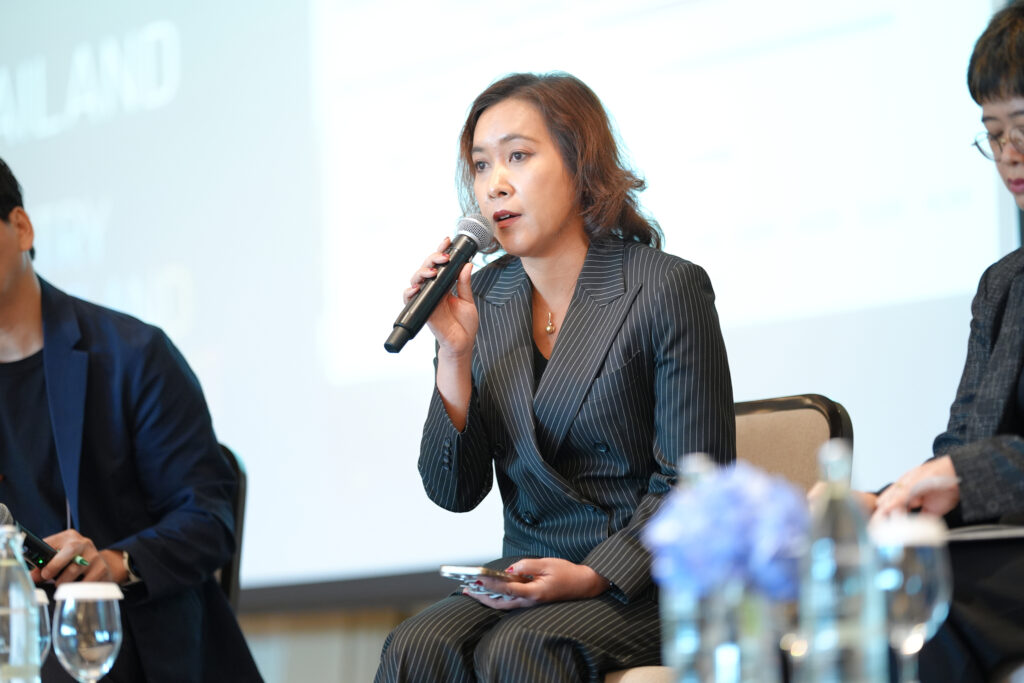
- Dr. Ornsaran Manuamorn, Senior Financial Sector Specialist, World Bank
- Chananun Supadulya, Director of Financial Institutions Strategy Department, Bank of Thailand
- Kamonphan Laksana, Head of Sustainability, TMBThanachart Bank Public Company Limited.
- Smitthi Harueanphuech, Chief Nature Based Solutions Officer, Mae Fah Luang Foundation
Together, they exchanged perspectives on the opportunities and challenges facing climate mitigation finance in Thailand, as well as ideas and practical experience for making such finance more effective.
World Bank: Thailand Should Attract International Finance
“Climate investment should not be viewed merely as a cost. It should be seen as a way to create new economic opportunities and strengthen Thailand’s competitiveness,” said Dr. Ornsaran
Dr. Ornsaran Manuamorn, Senior Financial Specialist at the World Bank began by outlining three key roles of the World Bank.
First, as a multilateral development bank, the World Bank provides financing to support climate-related investment projects in developing countries around the world. Thailand has also received support through initiatives such as the Low Carbon Cities and Carbon Market Development Project. However, Dr. Ornsaran noted that data from the Thailand Climate Finance Tracker 2026 show that international public finance still accounts for less than 1% of Thailand’s total climate investment. This gap represents a significant opportunity for the country.
Second, the World Bank serves as a global knowledge hub on development issues. Its international experience provides evidence on which policies and mechanisms can most effectively mobilise climate investment.
Third, the World Bank acts also as a convenor. Its global position enables it to work with countries to identify shared interests, set development agenda, and articulate common priorities to advance development and climate actions. This role will also be evident at the 2026 IMF-World Bank Group Annual Meetings, to be held in Thailand in October.
From the World Bank’s perspective, Thailand already has a relatively strong foundation for climate finance. This includes the Thailand Taxonomy, a target to achieve net-zero greenhouse gas emissions in line with the Paris Agreement by 2050, a growing sustainable finance market, and strengthened sustainability disclosure frameworks. These foundations place Thailand at “an implementation stage”, according to the Sustainable Finance and Banking Network (SBFN), which tracks global progress on sustainable finance.
At the same time, Thailand continues to face significant challenges. Dr. Ornsaran also highlighted two key findings from the World Bank’s 2025 Country Climate and Development Report.
First, climate change poses a major risk to Thailand’s economy. Thailand aims to become a high-income country by 2037, which would require annual GDP growth of approximately 5%. Without sufficient climate investment, however, climate impacts could reduce Thailand’s GDP by 7–14 percent by 2050.
The World Bank estimates that over the next 25 years, Thailand will need to invest approximately
USD 221-222 billion in climate action, equivalent to around 2.4% of the country’s cumulative GDP.
This includes:
1. USD 96 billion for climate mitigation;
2. USD 105 billion for climate adaptation; and
3. USD 20 billion for investments that generate both mitigation and adaptation benefits, such as mangrove restoration.

The World Bank’s findings are consistent with CFNT’s analysis in the Thailand Climate Finance Tracker 2026. Thailand continues to face investment gaps in critical infrastructure, including electric vehicle charging stations. It also lacks sufficient investment in systems that help vulnerable groups prepare for and reduce climate impacts, such as children and older people.
Second, Thailand has an opportunity to increase the value of its green exports. Dr. Ornsaran noted that green products already account for approximately 10% of the country’s total exports. Thailand has strong latent capabilities in electric vehicles, solar photovoltaics, and energy‑efficient cooling technologies. The next challenge is how to generate greater value from the green economy, and mobilize finance into green investments that support green industries.
Her final point was that Thailand should make greater use of international climate finance. According to the Thailand Climate Finance Tracker 2026, international public climate finance account for only around 1% of the finance used for climate action in Thailand. The country should therefore design projects that are capable of attracting more international climate finance. Dr. Ornsaran offered four recommendations:
1. Projects must have clear methods for measuring climate outcomes, while also demonstrating effectiveness and value for money.
2. Projects should generate wider development co-benefits alongside climate outcomes, such as creating new jobs, supporting small businesses or strengthening the country’s long-term competitiveness.
3. Projects should be structured to mobilise private investment, applying the private capital mobilization (PCM) approach to crowd in private capital.
4. Projects should build a long-term enabling ecosystem. The World Bank’s Low Carbon Cities and Carbon Market Development Project, for example, aims to establish a carbon credit aggregation mechanism, which is infrastructure that continues to benefit Thailand after the project itself has ended.
“If Thailand wants to make greater use of international finance, particularly international development finance, it must design projects that attract support. These projects need clear and measurable climate outcomes, development co-benefits, the ability to mobilise private capital and the capacity to strengthen the country’s ecosystem over the long term.” Dr. Ornsaran said.
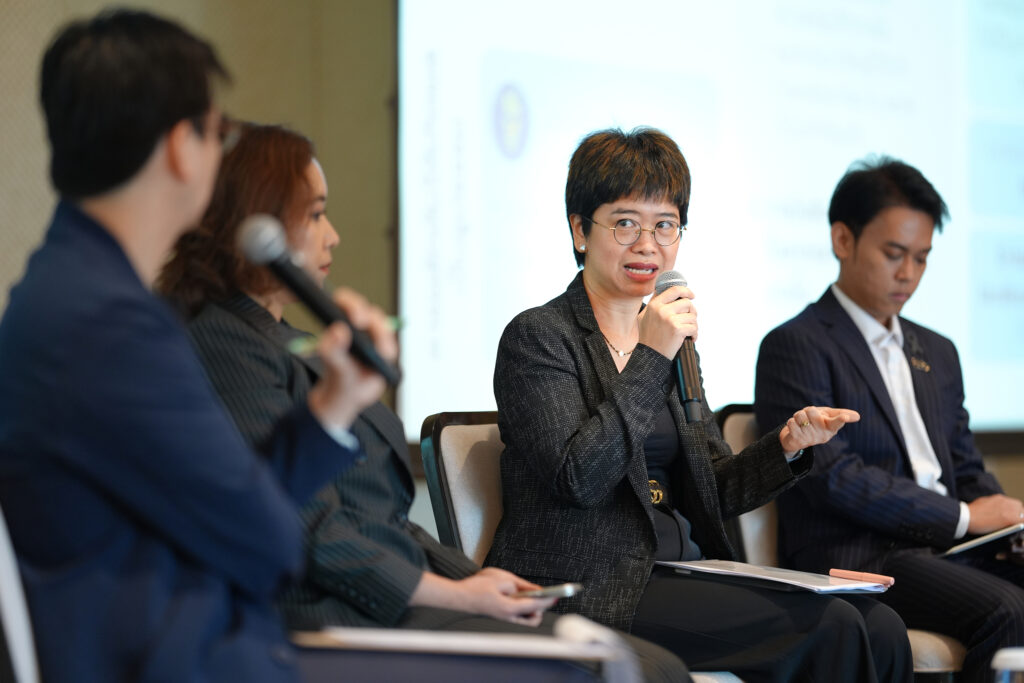
Bank of Thailand: Building a Financial Ecosystem for the Transition
Chananan Supadul, Director of the Financial Institutions Strategy Department at the Bank of Thailand (BOT), highlighted the significant progress Thailand has made in advancing climate finance.
In recent years, financial institutions have increasingly integrated environmental considerations into their business and decision-making processes. This is reflected in the growing adoption of sustainable finance targets, as well as the efforts of large banks (D-SIBs) to develop transition plans and work with their clients to navigate the transition towards a net-zero economy.
Chananan explained that the BOT is working to build a strong ecosystem for climate finance in Thailand through two key areas of work.
First, the BOT is establishing the key building blocks to lay the foundations for the ecosystem over the longer term. These include:
- Standard Practice – integrating environmental and climate considerations into the business processes and decision-making of financial institutions;
- Thailand Taxonomy – establishing a common classification system for economic activities; and
- Data & Disclosure – improving access to quality environmental data for businesses and financial institutions, while strengthening disclosures in line with international standards.
Second, the BOT is driving concrete action through the Financing the Transition initiative. The initiative works with commercial banks to develop financial solutions for businesses, particularly SMEs, while promoting total solutions that combine financing with non-financial support. The aim is to help businesses move from brown to less brown activities and ultimately transition towards a net-zero economy.
“We have learned that finance alone cannot deliver a genuine transition. Businesses also need awareness, an understanding of technology, and knowledge of emerging standards, such as green certificates, to turn these opportunities into their business” Chananan said.
Chananan highlighted two key challenges that Thailand needs to address to accelerate the transition towards a net-zero economy.
First, while Thailand now has its own Taxonomy, its practical adoption remains limited. This is partly because the Taxonomy criteria can be complex and require relevant environmental data. Many banks have not previously collected such information from their clients. To address this, the BOT is encouraging financial institutions to move towards more systematic implementation, including the classification of their lending portfolios according to the “color-code” categories under the Thailand Taxonomy.
Second, there remains a significant gap in businesses’ greenhouse gas (GHG) emissions data. This limits banks’ ability to accurately assess climate-related risks and monitor the transition progress of their clients. The BOT is therefore promoting connectivity between financial institutions and GHG data platform providers. This will help reduce the cost of accessing reliable data, improve the efficiency of risk assessment and credit evaluation, and enable financial institutions to better track whether financing is genuinely supporting businesses’ transition and delivering tangible climate outcomes.
“Taxonomy and data are key to delivering on Thailand’s NDC 3.0 ambition. We now have the Thailand Taxonomy as a common language, but having a ruler alone is not enough. We also need accurate and reliable data” Chananan said.
Looking ahead, Chananan emphasized that Thailand still has significant opportunities to further develop climate finance. More importantly, the country is increasingly moving in the right direction, with the foundations of the ecosystem being strengthened and efforts increasingly focused on translating these foundations into meaningful, real-world transition outcomes.
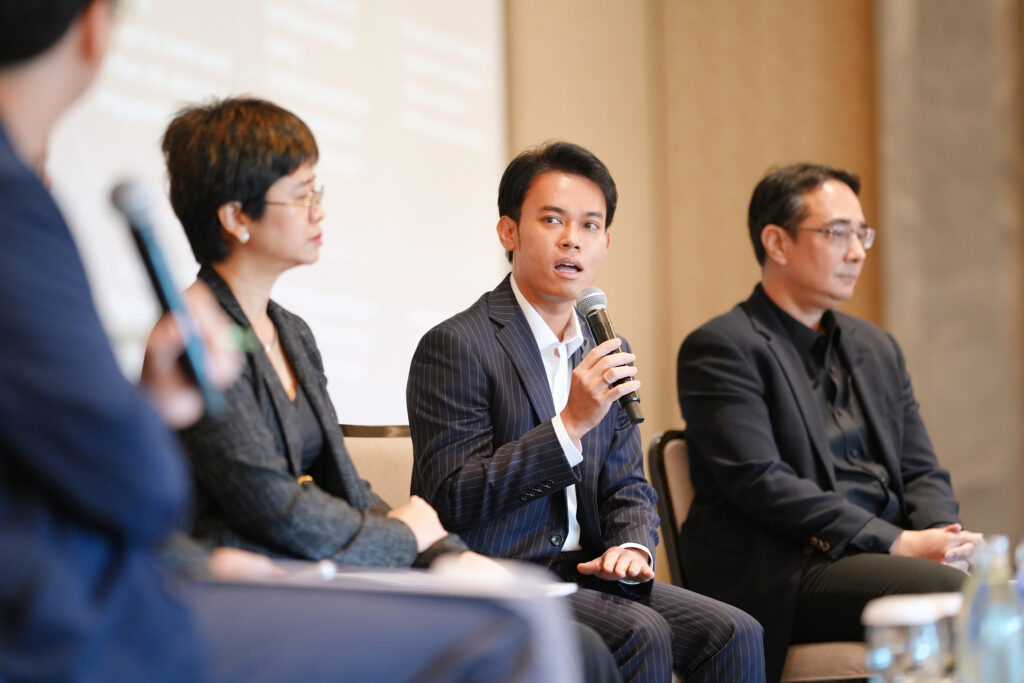
TMBThanachart Bank: Is the Finance Actually Reducing Emissions?
“The question in climate finance should not end with how much lending a bank has provided or how many bonds it has issued. We must also ask whether the money flowing out is actually reducing greenhouse gas emissions” said Kamonphan
Kamonphan Laksana, Head of Sustainability at TMBThanachart Bank Public Company Limited, reflected on the issue from the perspective of a commercial bank. Clients are becoming more aware of climate change and the growing number of related regulations. Their expectations of banks have consequently shifted towards a new question: “How can the bank help reduce the environmental impacts of our business?”
In response, TTB has developed a four-step framework for analysing its clients’ businesses.
1. Assess the risks including the European Union’s Carbon Border Adjustment Mechanism (CBAM), Thailand’s draft Climate Change Act and the potential introduction of a domestic carbon tax, as well as risks in global trade such as US tariff measures.
2. Analyze the risks faced by different client groups. The effects will vary between businesses. Steel producers, for example, face greater exposure to CBAM than food exporters.
3. Prevent for future risks by advising clients on how to begin measuring their business emissions and by organising seminars and training on the implications of emerging financial measures.
4. Provide solutions through financial products suited to each client, such as green loans or blue finance.
TTB continues to refine its framework for analysing and assessing clients’ future risks. This includes incorporating financed emissions, or the indirect greenhouse gas emissions associated with a financial institution’s lending, into its calculations. The bank has also developed a risk-assessment matrix with business growth on the X-axis and climate impacts on the Y-axis. This enables TTB to assess risks more precisely and design financial products for different client groups, such as green loan for energy sector and green loans for hotels sector.
Kamonphan added that TTB is aligning its sector-analysis framework with the Bank of Thailand’s Thailand Taxonomy. It is also developing tools that can measure clients’ environmental impacts more accurately and reduce the risk of greenwashing, which could damage rather than enhance a client’s reputation.
“Climate impact cannot be separated from a bank’s portfolio strategy. We need to understand what our portfolio looks like, how much it emits and whether our financial products are genuinely helping clients make the transition,” Kamonphan concluded.
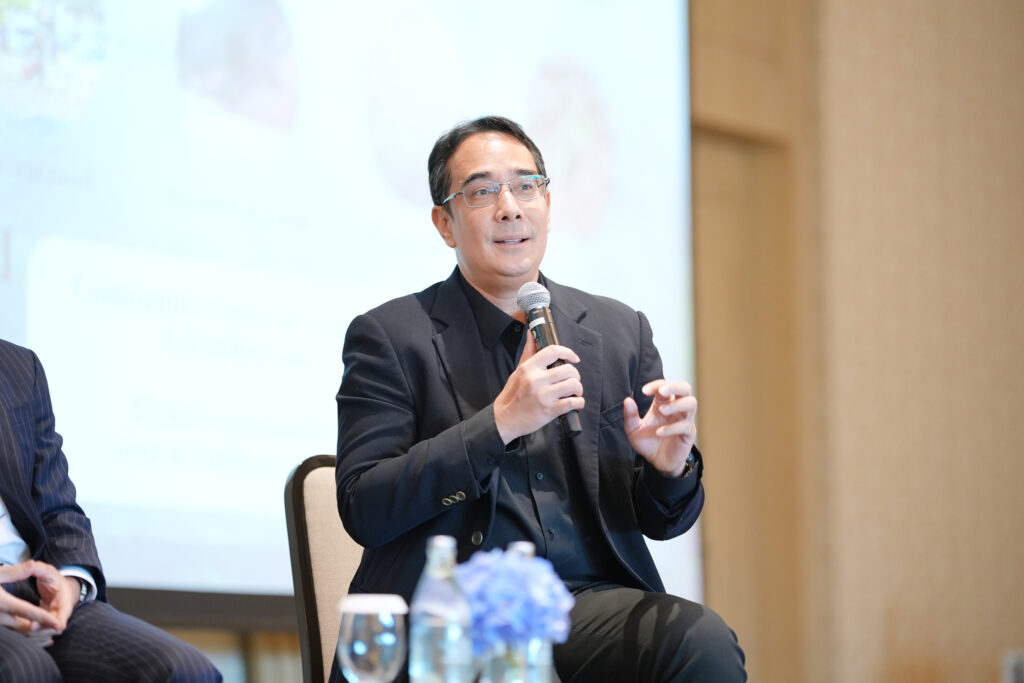
Mae Fah Luang Foundation: Enabling Communities to Protect Forests
“Forest conservation and restoration can deliver results when finance does not remain at the centre, but must reaches communities and enables local people to decide how the money should be used.” said Smitthi
Smitthi Harueanphuech, Chief Nature Based Solutions Officer, Mae Fah Luang Foundation, began with a lesson from the Mae Fah Luang Foundation’s work three decades ago. At the time, the Foundation sought to restore nature in Thailand and planted pine trees that were not native to the area. The approach proved unsuitable for the local ecosystem, highlighting that expanding and protecting forests requires an understanding of both ecosystems and communities.
Smitthi noted that Thailand’s Community Forest Act covers more than 6.8 million rai across 13,000 communities, where approximately 4.5 million people live. Forests and communities therefore cannot be separated. Since 2021, the Mae Fah Luang Foundation has worked with communities on forest conservation, introducing carbon credit mechanisms at the local level so that community members can both protect forests and generate income from sustainably managing their own forest/natural resources.
The Foundation currently works with 303 communities across Thailand, covering more than 287,000 rai of forest. Over the past six years, from 2021 to 2026, it has channeled more than THB 260 million from private sector partners to communities. Community members collectively decide how the fund should be used, with the Foundation providing guidance.
Beyond carbon credits, the Foundation has collaborated with GISTDA, GEOSAC and THAICOM to apply satellite imagery to wildfire management. Satellite data are combined with community knowledge so that residents can identify fire locations and prevent severe fires from spreading to and affecting community forests. In Ban Sop Pong, Pang Mu Subdistrict, Mueang District, Mae Hong Son Province, the initiative reduced the share of wildfire that entered the community area from 58% to 26% within one year.
“When mechanisms and incentives are designed correctly, everyone can change their behaviour. If villagers earn sufficient income from protecting forests, they will help conserve them because they also benefit from the forests. The same applies to businesses. With the right incentives and environmental knowledge, companies can operate in ways that create positive environmental outcomes,” said Smitthi.
In the long term, Smitthi hopes that businesses will be able to calculate the true environmental costs of their operations and use this understanding to reduce their environmental impact, an area in which he understands the World Bank is currently working on.
From More Finance to More Effective Finance
Although the panellists approached the issue from different positions, they shared a common message: climate finance cannot be measured solely by the value of loans or the number of projects. The financial system needs accurate data, verifiable targets and mechanisms that ensure capital reaches businesses and communities capable of delivering real results.
Thailand’s next step is therefore not simply to increase the volume of investment. It is to ensure that every baht invested contributes to lower greenhouse gas emissions, greater competitiveness and a just transition for people at every level.
Further information:
- Thailand Climate Mitigation Finance 2026: https://www.climatefinancethai.com/tracker/mitigation
- Thailand Climate Adaptation Finance 2026: https://www.climatefinancethai.com/tracker/adaptation