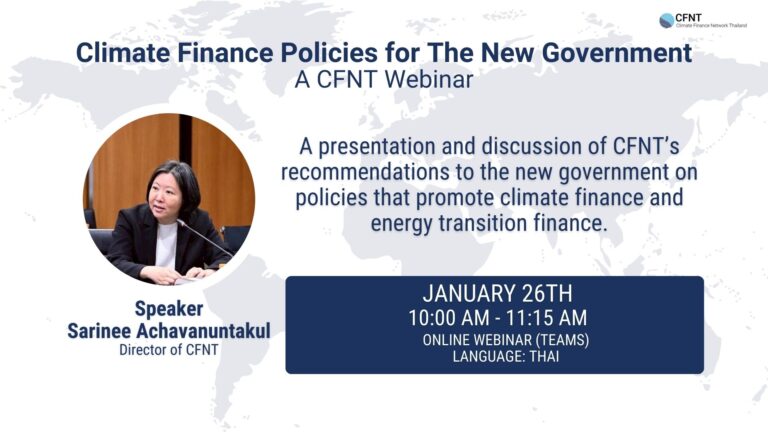
Climate Finance Policies for the New Government
‘Climate Finance Policies for the New Government’, presented by Sarinee Achavanuntakul, Director of CFNT
Thailand’s Net Zero 2050 target under NDC 3.0 can be achieved depends largely on the energy sector. Rapeepat Ingasit explores 3 pathways for phasing out coal, drawing on international experience that is not only climate-friendly, but also economically viable.
As Southeast Asia becomes the world's second-fastest-growing electricity market, the region faces two main paths. One is to commit to massive infrastructure to import Liquefied Natural Gas (LNG). The other path is accelerating renewable energy adoption, which requires a major update of the regional grid.
How Thai - Cambodia conflict may affect climate finance, and how instability may be not just slow but reverse the future of Thai energy transition?
In late July, electric vehicle (EV) company Omoda & Jaecoo announced it would increase investment in Thailand after pledging to build a manufacturing plant. A subsidiary of Chery Automobile, it is the latest in a wave of Chinese EV companies setting up production in Thailand’s Eastern Economic Corridor. The surge in Chinese EV investment is […]
Thailand is taking a significant step towards renewable energy, targeting half of its electricity generation from renewable sources by 2037 under the recently drafted Power Development Plan 2024 (PDP2024). However, achieving this goal is dependent on the Asean Power Grid, a region-wide initiative first proposed in 1997 to interconnect the electricity infrastructures of Asean member […]
Thailand’s rising electricity costs are not just a concern for businesses; they are placing a financial burden on schools. In 2023, a local business daily, Bangkok Biz, reported that many schools were struggling with high electricity liabilities. For example, Mahidol Wittayanusorn School, located on the Salaya Campus of Mahidol University in Nakhon Pathom province, faces […]
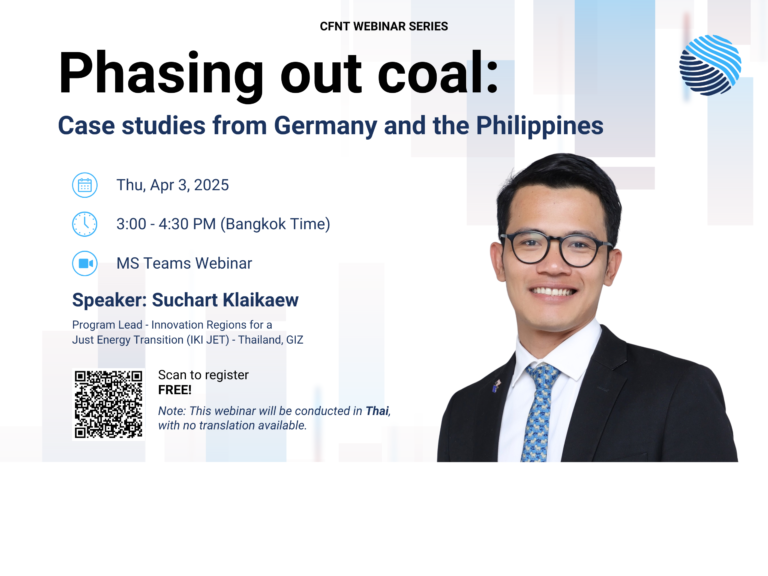
As countries transition toward clean energy, what can Thailand learn from Germany and the Philippines about phasing out coal? Join CFNT’s exclusive webinar featuring Suchart Klaikaew, Program Lead for Innovation Regions for a Just Energy Transition (IKI JET) Thailand at Deutsche Gesellschaft für Internationale Zusammenarbeit (GIZ) GmbH, as we explore the challenges of coal power […]
At first glance, the idea of combining agriculture with solar energy seems far-fetched. How can crops and solar panels compete for the same sunlight? My view changed after I visited the Sosa Mega Solar Sharing site in Chiba Prefecture, Japan, last month. As part of a media tour organised by Mekong Watch, a Japanese non-profit […]
In Thailand’s National Energy Plan (NEP) — a blueprint outlining the country’s energy strategy from 2023 to 2037 — a small portion of nuclear energy is included as one form of alternative energy. The NEP has set the goal that 50% of energy for consumption must come from clean and renewable sources like wind, solar, […]