An Irresponsible Path to Net Zero: A Critique of Draft PDP 2026
Download the full analysis of CFNT's critique on Thailand's draft PDP2026.

Download the full analysis of CFNT's critique on Thailand's draft PDP2026.
Rocket Media Lab and CFNT dig deep into Thai's energy corporation invested in energy transition, drawing on the Thailand Climate Finance Tracker 2026 database.

how Thailand is preparing for the uncertainty of climate change? This question was at the heart of the panel discussion, “From Chaos to Resilience: Co-Designing Climate Adaptive Future,” held during the launch of the 2025 Climate Finance Tracker: Uncovering Thailand’s Flows

The government's proposed "Jump Start" plan aims to accelerate Thailand's energy transition through a 200-billion-baht stimulus package. But is more public borrowing really necessary? In this article, Sarinee Achavanuntakul, Director of CFNT, outlines four alternative pillars for a genuine just energy transition that could be implemented immediately—without taking on an additional 200 billion baht in debt.

For the poorest households in Thailand, energy is one or the most expensive monthly bill. Nawaphat explain how to fix these issues with five practical steps, that do not require money.
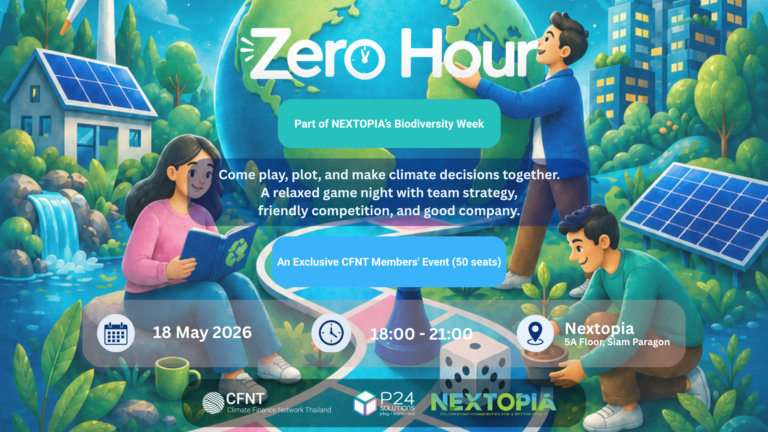
You're invited to CFNT membership event, board game night on 18 May 2026 at Nextopia, Siam Paragon.
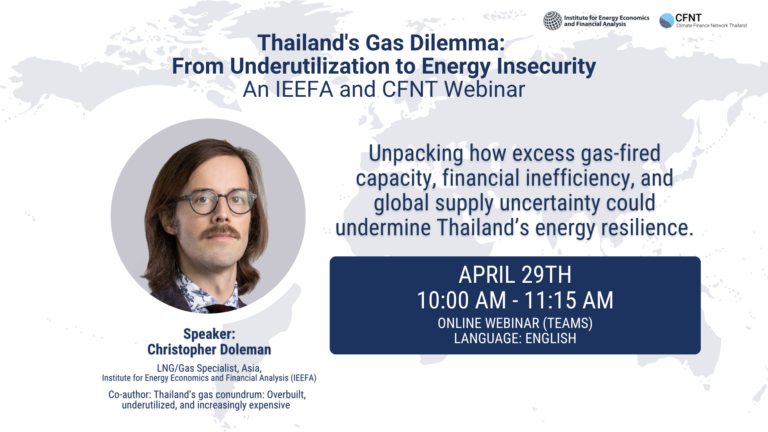
CFNT webinar recording “Thailand and Natural Gas: From Capacity Challenges to Energy Insecurity” featuring Christopher Doleman LNG/Gas Specialist, Asia, IEEFA and co-author of IEEFA’s new report, “Thailand’s Gas Conundrum: Overbuilt, Underutilized, and Increasingly Expensive”

Iran war is once again challenging the global economy. For Thailand, however, it exposes something deeper -- an energy system that remains heavily dependent on imported LNG.
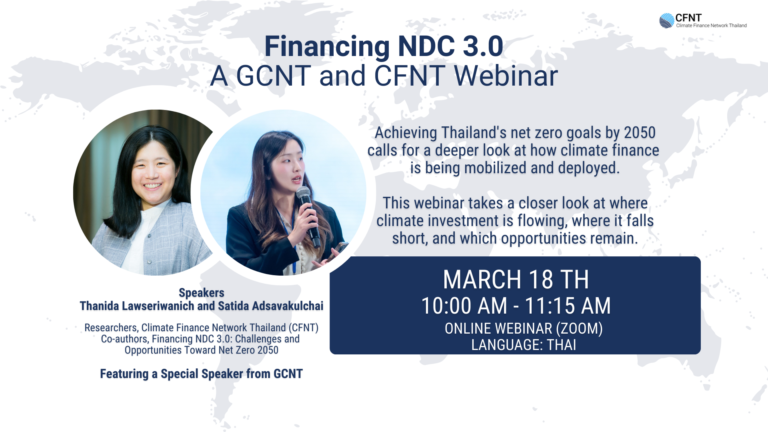
Thailand has recently demonstrated a major step forward in climate ambition through its NDC 3.0, to transition toward a net-zero society and economy by 2050. However, ambition alone is not enough. Climate Finance Network Thailand (CFNT), in collaboration with UN Global Compact Network Thailand (GCNT), invites you to explore these issues in our webinar “Financing NDC 3.0.”
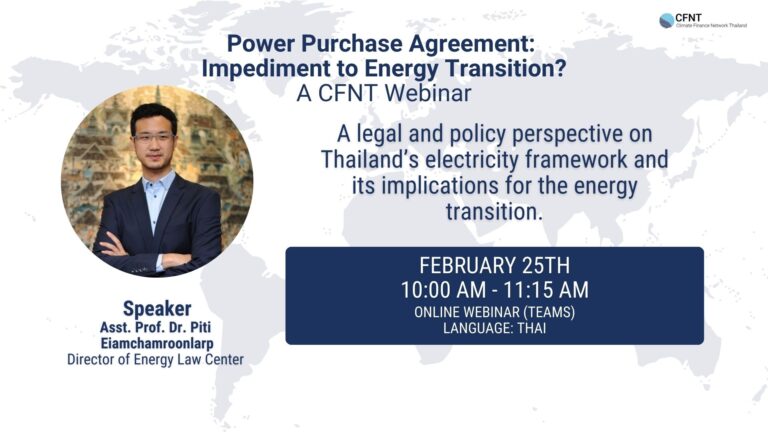
CFNT webinar “Power Purchase Agreement: Impediment to Energy Transition?”, featuring Dr.Piti Eiamchamroonlarp, Director of the Energy Law Center and Assistant Professor at the Faculty of Law, Chulalongkorn University.