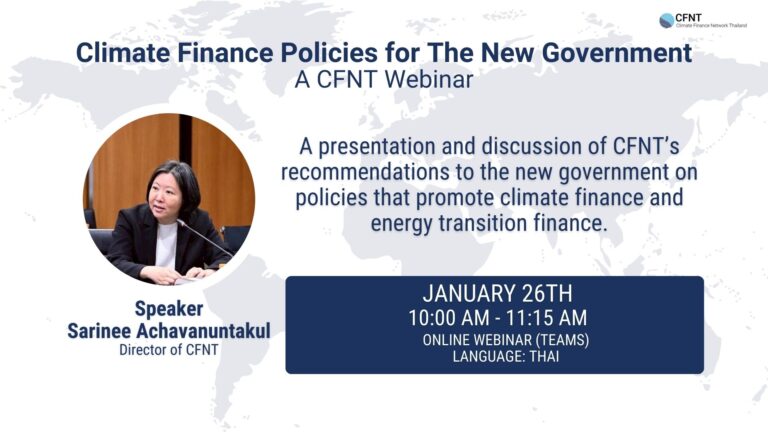
CFNT Webinar Series: Climate Finance Policies for the New Government
CFNT and Fair Finance Thailand (FFT) propose 10 climate finance policies for Thailand's new governmen, based on research conducted by both organizations
As the effects of global warming increasingly and adversely impact Thai society and the economy, Climate Finance Network Thailand (CFNT) and Fair Finance Thailand (FFT) propose 10 financial and finance-related policies to drive Thailand’s just transition by addressing 3 key problem areas.
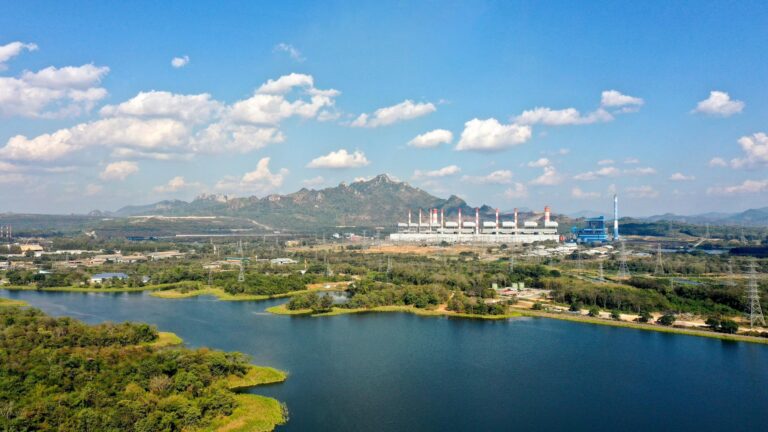
Thailand’s Net Zero 2050 target under NDC 3.0 can be achieved depends largely on the energy sector. Rapeepat Ingasit explores 3 pathways for phasing out coal, drawing on international experience that is not only climate-friendly, but also economically viable.
Thailand's NDC 3.0 mentions “just transition” for the first time. But the question remains: how can we ensure that this becomes a real just transition and advances climate justice in practice? Sarinee proposes three recommendations to align Thailand’s Climate Fund with the principles referenced in NDC 3.0.
As Southeast Asia becomes the world's second-fastest-growing electricity market, the region faces two main paths. One is to commit to massive infrastructure to import Liquefied Natural Gas (LNG). The other path is accelerating renewable energy adoption, which requires a major update of the regional grid.
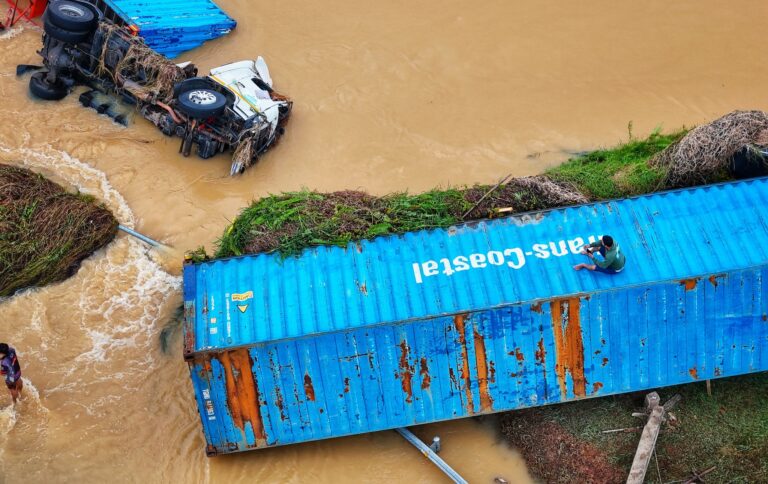
Thailand has made progress in disaster preparedness since the 2011 mega floods — but the real challenge now is shifting from disaster prevention to climate adaptation.
Summary a panel discussion ‘Financing Climate Action in Bangkok –Challenges & Opportunities,' featuring international experts on climate finance, who deliberated on the key barriers to increasing climate financing, lessons learned from global experiences, and insights for strengthening resilience in Bangkok and other major Asian cities facing climate change.
How Thai - Cambodia conflict may affect climate finance, and how instability may be not just slow but reverse the future of Thai energy transition?
In late July, electric vehicle (EV) company Omoda & Jaecoo announced it would increase investment in Thailand after pledging to build a manufacturing plant. A subsidiary of Chery Automobile, it is the latest in a wave of Chinese EV companies setting up production in Thailand’s Eastern Economic Corridor. The surge in Chinese EV investment is […]
How much can Chinese EV investment truly contribute to Thailand’s green transformation? Let's find the answers in our online seminar.