
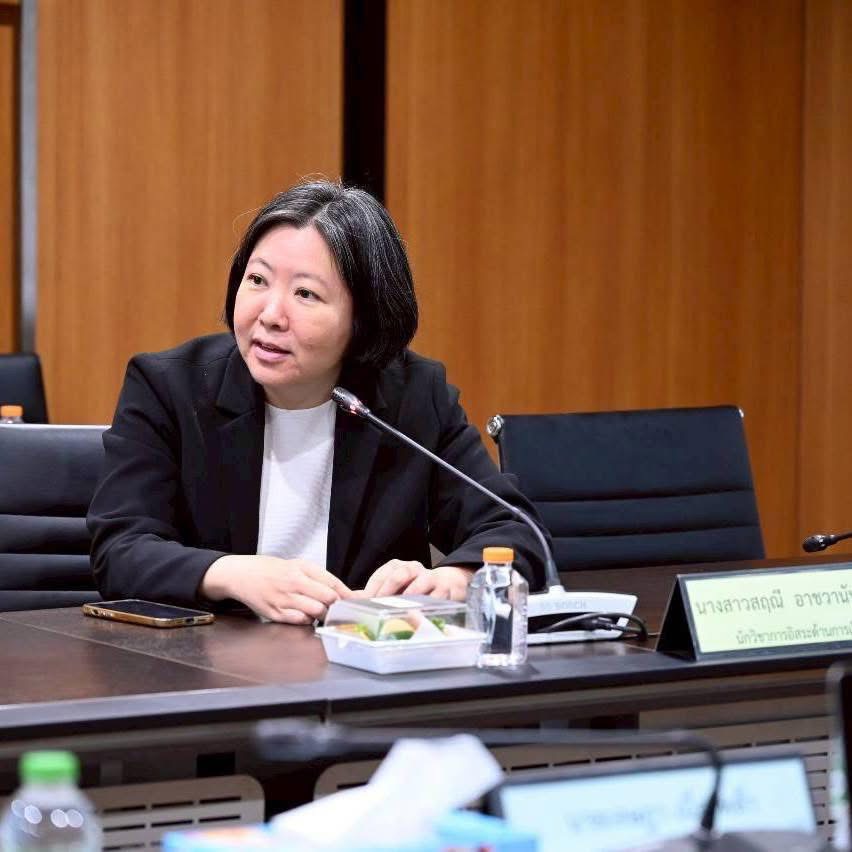
BANGKOK, 26 January 2026 — Climate Finance Network Thailand (CFNT), the think tank promoting sustainable financial practices and advancing Thailand’s low-carbon transition, and Fair Finance Thailand (FFT) today hosted an online seminar titled ‘Climate Finance Policies for the New Government.’ The seminar was led by Sarinee Achavanuntakul, Director of CFNT and Head of Research at FFT, who presented ten climate finance policy proposals to the government that will be formed after the upcoming Thailand general election.
“Thailand’s transition towards a more sustainable and equitable economy must go beyond just voluntary measures; it must be balanced with mandatory policies that establish minimum standards to create a more level playing field for society and businesses,” said Sarinee Achavanuntakul, Director, Climate Finance Network Thailand and Head of Research, Fair Finance Thailand. “As the climate crisis continues to adversely impact Thai society and economy, climate finance policies must be incorporated as a key policy platform to ensure that one is left behind during the country’s just energy transition.”
Alongside the impacts of extreme heat on outdoor workers, and losses caused by flooding, drought, and coastal erosion, the World Bank estimates that Thailand’s GDP could decline by 7-14% by 2050 without timely and sufficient investment in climate adaptation. In light of this urgency, CFNT and FFT during the seminar presented ten policy proposals aimed at resolving three major challenges, based on research conducted by both organizations:
Climate Adaptation Investment in Thailand is Insufficient and Untimely
Data from CFNT’s Thailand Climate Finance Tracker shows that Thailand faces a significant climate adaptation finance gap. Between 2020 and 2024, total investment in climate adaptation amounted to THB148,096 million, or an average of THB29,619 million per year, representing only 15–18% of the annual adaptation finance required. Thailand’s Nationally Determined Contribution (NDC) 3.0 also does not yet specify principles or operational guidelines aligned with the concept of a just transition, and remains vulnerable to being dominated by vested interests. CFNT and FFT propose three policy measures to address this challenge:
- Define clear criteria for the Climate Fund in Thailand’s Change Act, emphasizing support for climate adaptation activities for communities, vulnerable groups, fossil industry workers, and SMEs according to just transition principles
- Prioritize state climate mitigation investments based on cost-effectiveness principles and establish criteria for supporting Net Zero investments according to scientists’ recommendations, not according to the demands of interest groups
- Support the development of new climate finance innovations, especially for climate adaptation, as well as loss and damage compensation
Financial Institutions Continue to Support Fossil Fuel and Large Hydropower Projects
This challenge is largely due to existing long-term take-or-pay Power Purchase Agreements (PPAs) between private power producers, large hydropower projects, and power utility providers—resulting in Thai consumers bearing inflated electricity costs over the past two decades. These projects also offer strong financial incentives for banks, as they are large-scale investments with state-guaranteed returns. To address this issue, CFNT and FFT propose four policy measures:
- Expedite the passing of the Climate Change Act and announce the implementation of mandatory carbon pricing mechanisms for the energy sector
- Announce all coal-fired power plants must be phased out by 2035
- The Thailand Taxonomy working group should fully apply the “Do No Significant Harm” (DNSH) principle from the EU Taxonomy to hydropower projects
- The Bank of Thailand should require all banks to develop transition plans for loan and investment portfolios in the energy sector
Renewable Energy and Energy Efficiency Measures Require Better Financial Access
CFNT’s 2024 research report, Here Comes Everybody: Boosting Residential Solar Financing with Crowdfunding Models in Thailand, finds that households face significant barriers to accessing finance from formal financial institutions for residential solar rooftop installations.CFNT and FFT propose three policy measures to address this:
- Issue measures supporting instalment payments for solar energy and energy-saving equipment installation at the community and household levels through electricity bills
- The Bank of Thailand should announce a reduction in risk weights for renewable energy projects and energy efficiency measures from 100% to 50%
- Gradually eliminate state fossil fuel subsidies and instead provide tax benefits to support renewable energy and energy efficiency measures
These policy proposals build upon recommendations presented at the event “#Election ’26: Thai Energy Policy toward Net Zero 2050,” organized by JustPow, a collaboration of organizations working on energy and environmental data, knowledge, and communication. The event brought together nine academics and experts from various organizations, including CFNT and FFT, to present energy policy recommendations to representatives from political parties.
To learn more about the policy proposals by CFNT and FFT in more detail, download the full report at:
www.climatefinancethai.com/climate-finance-policy-recommendations-for-thailands-new-government-in-2026