
Climate Finance Network Thailand (CFNT), a Bangkok-based think tank and network working to accelerate the flow of finance toward climate mitigation and adaptation in Thailand, released findings from the Thailand Climate Finance Tracker 2026, a national database that tracks investments in both climate mitigation and climate adaptation across the public sector, private sector, financial institutions, and international development partners. The findings were presented during the “2026 Climate Finance: Time to Walk the Talk,” held on 23 July 2026.
Thailand Climate Mitigation Finance 2026
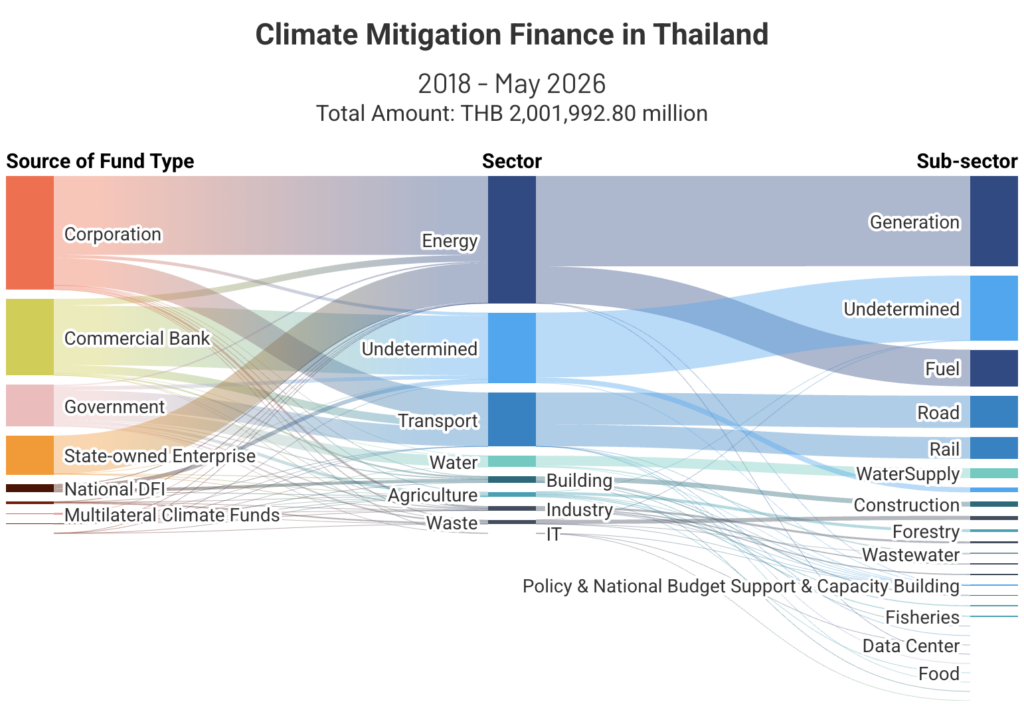
The Tracker shows that cumulative investment in climate mitigation between 2018 and May 2026 reached approximately THB 2 trillion, an increase of 26% compared with the 2025 edition. The private sector and commercial banks remained the largest sources of finance, contributing THB 1.3 trillion, or more than two-thirds of total mitigation investment. The energy and transport sectors received the largest share of investment, together accounting for more than two-thirds of Thailand’s total climate mitigation finance.
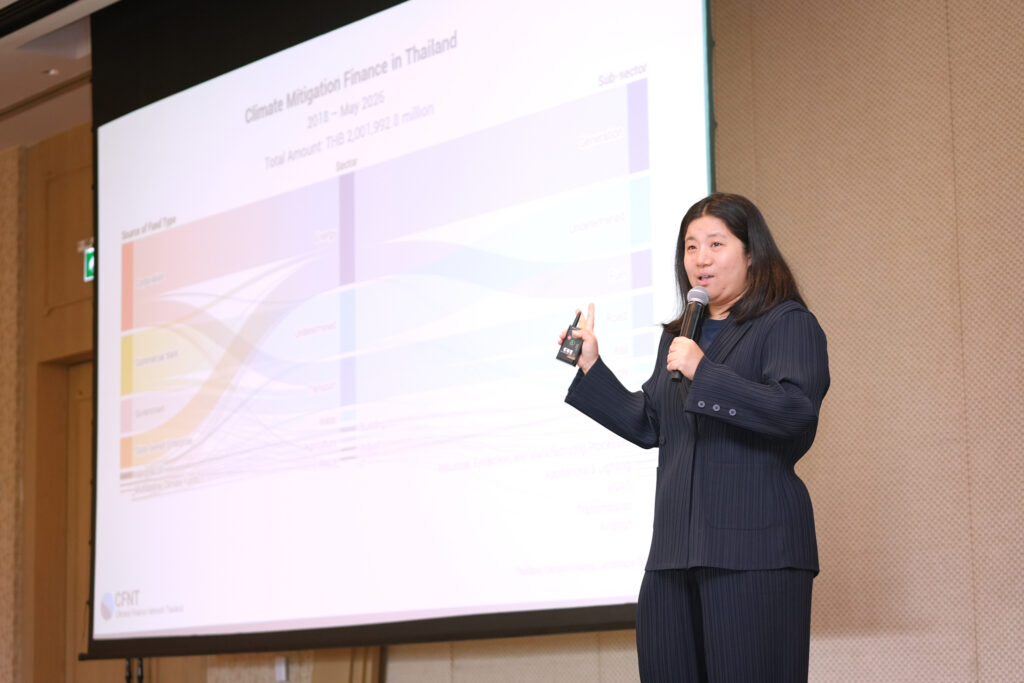
“Thailand continues to face a significant investment gap in the enabling infrastructure needed to support low-carbon technologies, particularly in the energy and transport sectors. Investments in electric vehicle charging networks and electricity grid modernization account for less than 1% of the total sectoral investment. Addressing this infrastructure gap will be critical to ensuring that Thailand’s climate investments deliver the greatest value and accelerate the transition to a low-carbon economy.” Thanida Lawseriwanich, Head of Research at Climate Finance Network Thailand said during presentation.
Despite this growth, the findings highlight two major investment efficiency challenges that could limit Thailand’s progress towards its climate goals.
The first challenge is the prioritisation of technologies with relatively high abatement costs. Thailand’s current policy direction places increasing emphasis on technologies such as Small Modular Reactors (SMRs) and Carbon Capture and Storage (CCS), both of which require substantial capital investment while remaining subject to considerable technological and commercial uncertainty. In contrast, more mature and cost-effective solutions—including wind power or early coal phaesout—receive comparatively less attention in Thailand’s energy policies.
The second is the underinvestment in enabling infrastructure that is essential for the transition to a low-carbon economy. In the energy sector, more than 99% of mitigation finance has been directed towards renewable electricity generation and fuel production, while investment in enabling infrastructure such as smart grids remains limited. A similar pattern is observed in the transport sector, where investment has focused primarily on low-carbon vehicle technologies, with comparatively little financing allocated to supporting infrastructure such as electric vehicle charging networks.
Based on these findings, CFNT recommends four priority actions to improve the investment effectiveness of climate mitigation finance in Thailand:
- Prioritise public investment based on abatement costs, using the cost per tonne of CO₂ equivalent reduced as a key criterion for investment decisions.
- Introduce a mandatory carbon pricing mechanism for the energy sector under Thailand’s forthcoming Climate Change Act.
- Reduce the regulatory risk weight applied to clean energy investments from 100% to 50%, enabling financial institutions to expand lending for clean energy projects.
- Promote household solar adoption through On-Bill Financing, allowing households to repay rooftop solar installation costs through their monthly electricity bills.
For more information about Thailand Climate Finance Tracker 2026: www.climatefinancethai.com/tracker/mitigation
Thailand Climate Adaptation Finance 2026
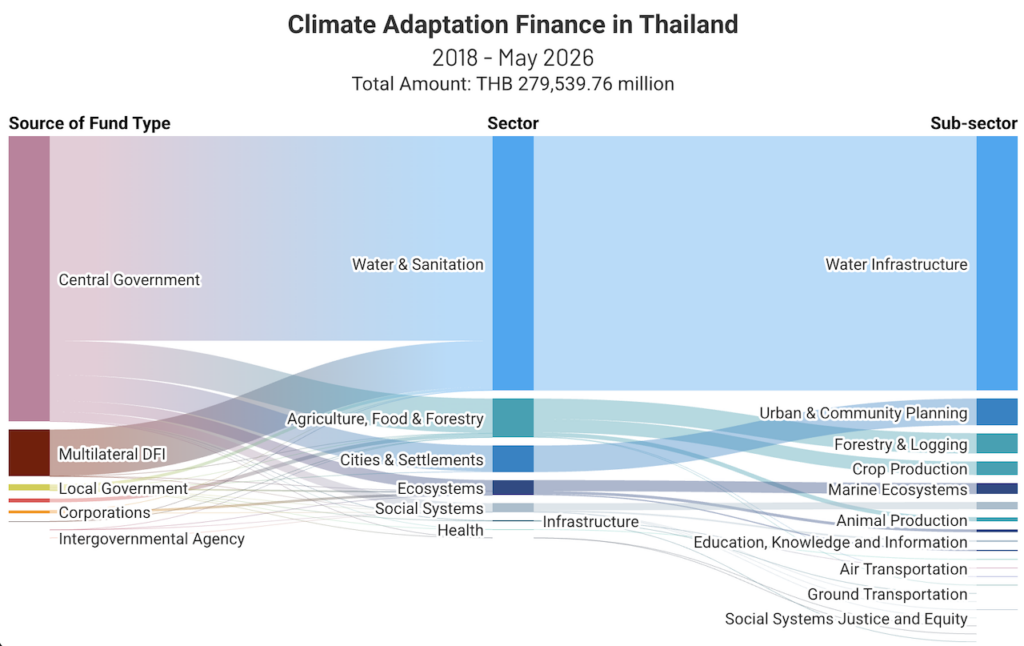
Thailand’s climate adaptation landscape, compiled by CFNT in collaboration with the Puey Ungphakorn Institute for Economic Research (PIER) shows that cumulative climate adaptation finance between 2018 and May 2026 reached approximately THB 279.5 billion, more than doubling compared with the 2025 edition. The public sector remained the primary source of adaptation finance, accounting for 81% of total investment. Investment also remained highly concentrated in the water sector, which received approximately three-quarters of total adaptation finance, while the health sector received less than 1%.
Although adaptation finance has increased substantially, Thailand continues to face a high level of climate risk. According to the Climate Risk Index 2024, Thailand ranks as the 17th most climate-vulnerable country in the world, yet only 123rd in climate readiness from the readiness index, highlighting a significant gap between climate risk and the country’s capacity to respond effectively.
The findings identify two major challenges in Thailand’s adaptation finance landscape.
The first is the insufficient allocation of finance to vulnerable populations. While Thailand’s NDC 3.0 recognizes the importance of protecting vulnerable groups, it does not establish a clear implementation framework or dedicated budget allocations. At the same time, investment in social system, justice, and equity remains extremely limited, receiving only THB 44 million out of Thailand’s total climate adaptation finance.
The second is the reliance on single-purpose grey infrastructure, particularly in the water and sanitation sector. While such investments may reduce climate risks in the short term, they can ultimately lead to maladaptation by undermining long-term climate resilience. This is illustrated by the flooding in Hat Yai District, Songkhla Province, in late 2025.
“In Thailand’s climate adaptation finance landscape, the public sector remains the country’s primary investor, accounting for more than 80% of total adaptation finance. Looking ahead, greater participation from the private sector will be essential. This can be achieved through blended finance mechanisms, where the public sector assumes part of the initial investment risk, helping to mobilize private capital and unlock greater investment in climate adaptation.” Thanida said during presentation.
The brief, Highlights from the 2026 Edition of Thailand Climate Finance Tracker: Introducing Maladaptation, was produced by CFNT and Pakkasem Tongchai, Water and Wetlands Programme Officer at the International Union for Conservation of Nature (IUCN), recommends three priority actions to strengthen the effectiveness of climate adaptation finance in Thailand:
1.Screen and rebalance water infrastructure by increasing investment in green infrastructure alongside existing gray infrastructure, while strengthening disaster risk management systems to improve community resilience.
2. Target the vulnerable at community level by decentralizing adaptation planning, budgeting, and policy design, with particular attention to vulnerable populations. This includes measures such as developing heat-health maps for children.
3. Mobilise greater private sector investment through innovative financing mechanisms, including microfinance, blended finance, and pooled financing approaches to improve access to the Loss and Damage Fund.
For more information about Thailand Climate Finance Tracker 2026: www.climatefinancethai.com/tracker/adaptation