
The floods in Hat Yai district, Songkhla province, in late 2025, and the floods in Nan province in August this year are warning Thailand about the increasing variability and severity of climate-related disasters.
The Climate Risk Index (CRI) 2026 ranks Thailand 17th in the world among countries at high risk from climate-related extreme weather events. Meanwhile, the Readiness Ranking places Thailand 123rd globally in terms of its readiness to respond to climate change. These rankings reflect Thailand’s urgent need to become better prepared for climate impacts. This includes developing long-term plans, allocating budgets and integrating cooperation among the public sector, private sector and international organisations.
The question is: how prepared is Thailand today for the climate volatility that is intensifying around the world?
Rocket Media Lab and Climate Finance Network Thailand (CFNT) invite to explore climate adaptation finance across Thailand’s provinces, drawing on the Thailand Climate Finance Tracker 2026 database. The tracker covers investment in both greenhouse gas mitigation and climate adaptation, including public- and private-sector investment as well as domestic and international sources of finance, such as financial institutions and international organisations.
The 2026 climate adaptation finance landscape data were compiled by CFNT in collaboration with the Puey Ungphakorn Institute for Economic Research (PIER), covering the period from 2018 to May 2026. Together, these data help answer three questions: how much has Thailand invested in climate adaptation, which sectors have received this investment, and how prepared is the country to respond to climate change?
How much climate adaptation finance has been invested across Thailand?
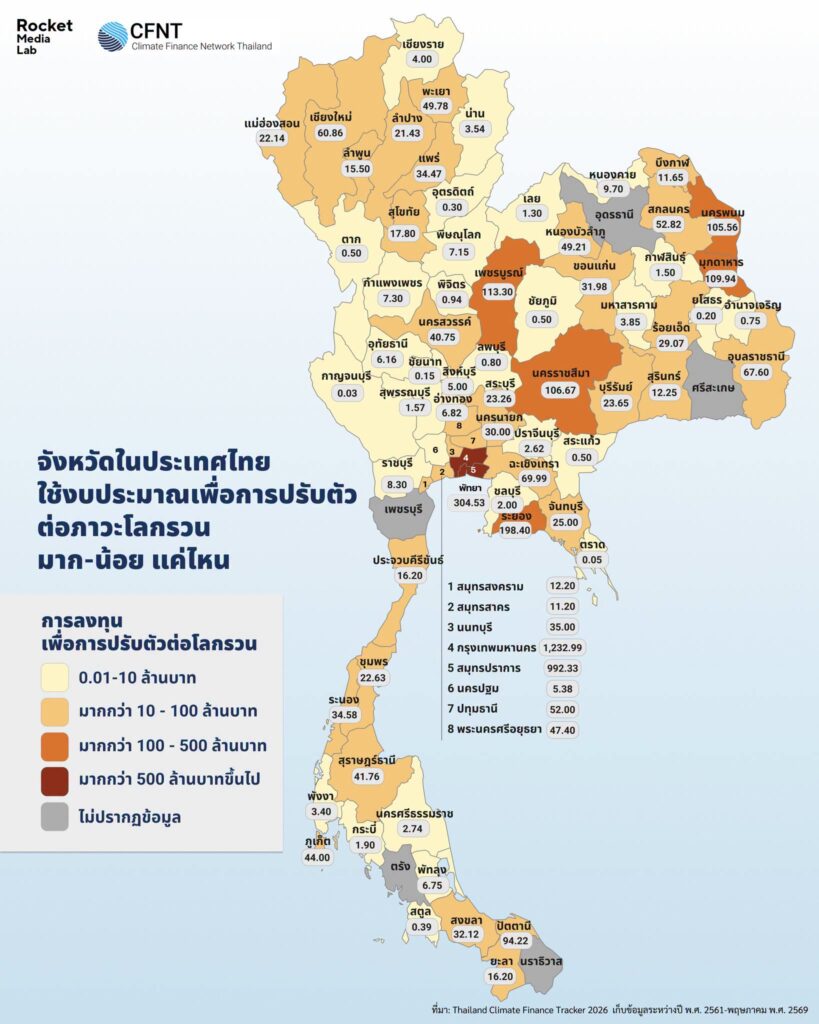
Overall, data from the Thailand Climate Finance Tracker 2026 show that between 2018 and May 2026, Thailand invested a total of THB 279.5 billion in climate adaptation finance – defined as all forms of investment intended to prepare for, respond to or adapt to climate change. The public sector remains the principal investor, accounting for more than four-fifths of all climate adaptation finance in Thailand.
At the local level, the annual budgets for 2025-2026 identify 1,605 projects classified as climate adaptation. Of these, 531 projects fall under the budgets of Provincial Administrative Organisations and local administrative organisations.
When classified by location, the five areas with the highest budgets for climate adaptation were:
Bangkok: THB 1,232.99 million, drawn from the Bangkok Metropolitan Administration’s 2026 annual budget. All projects were related to drainage, including the construction of embankments, drainage tunnels and flood protection systems.
Samut Prakan province: THB 992.33 million.
Pattaya City, a special-form local administrative organisation: THB 304.53 million.
Rayong province: THB 198.40 million.
Phetchabun province: THB 113.30 million.
The provinces with the lowest budgets for climate adaptation were Uttaradit, Yasothon, Chai Nat, Trat and Kanchanaburi, respectively.
Although Bangkok had the highest climate adaptation budget, it had only 11 projects.
Nakhon Phanom, by contrast, had the largest number of projects classified as climate adaptation investment, with 83 projects. Almost all were open-system groundwater bank projects intended to increase water reserves and store water for use during the dry season as part of a sustainable response to drought and flooding. These projects were distributed across several areas of Nakhon Phanom province.
The data also show that only two areas – Bangkok and Samut Prakan – had climate adaptation budgets exceeding THB 500 million. Twelve provinces had budgets below THB 1 million, while no data appeared for five provinces: Trang, Narathiwat, Phetchaburi, Si Sa Ket and Udon Thani.
Which sectors receive the most climate adaptation finance?
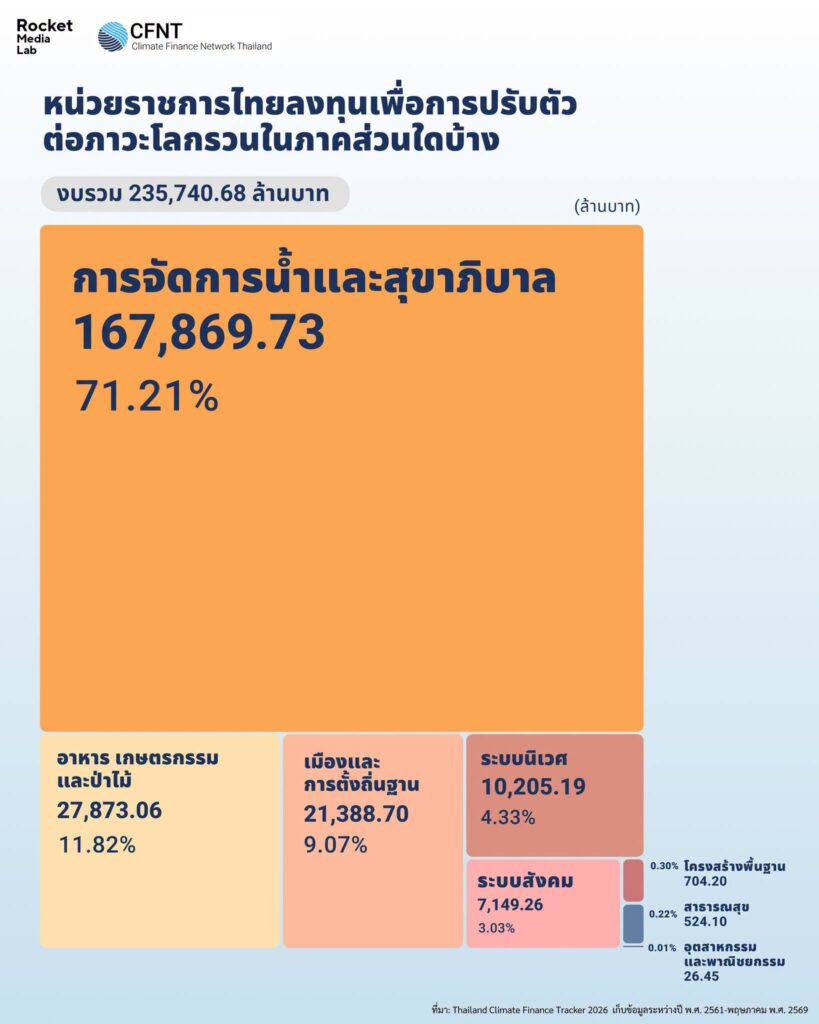
When public-sector climate adaptation investment is classified using the economic-sector classification system, it falls into eight sectors:
- Water and sanitation
- Ecosystems
- Cities and human settlements
- Public health
- Social systems
- Infrastructure
- Food, agriculture and forestry
- Industry and commerce
The public sector allocated the largest share of its budget to water-related projects: THB 167,869.73 million, or 71.21% of the total THB 235,740.68 million in public-sector budgets classified as climate adaptation investment.
At the provincial level, the greatest investment in water-related projects was found in Bangkok and in northeastern provinces such as Mukdahan, Nakhon Phanom and Nakhon Ratchasima. Most of these projects were undertaken by the Ministry of Agriculture and Cooperatives.
The second-largest category was food, agriculture and forestry. This encompasses investment in systems for producing and supplying food and related products, from primary production to distribution. Climate response and adaptation investment in this category totalled THB 27,873.06 million, or 11.82%.
At the provincial level, the greatest investment in this group was found in Bangkok, including projects to maintain, improve and expand green spaces, followed by Surat Thani. Most were projects of the Ministry of Natural Resources and Environment.
Next were projects related to cities and human settlements: investment intended to enable communities and human settlements in both urban and rural areas to respond to climate change. This category totalled THB 21,388.70 million, or 9.07%.
At the local level, the greatest investment in this group was found in Bangkok and Pattaya City. Most were projects of the Ministry of Interior.
Ecosystem-related projects refer to investment concerning terrestrial, freshwater, coastal and marine ecosystems, as well as biodiversity, natural capital and ecosystem services, for responding and adapting to climate change. Investment in this category totalled THB 10,205.19 million, or 4.33%.
At the provincial level, the greatest investment in this group was found in the coastal provinces of Samut Prakan and Rayong. Most were projects of the Ministry of Natural Resources and Environment.
Projects related to social systems refer to investment in systems and services concerning well-being, safety and social security, intended to strengthen the capacity to respond to climate change. Investment in this category totalled THB 7,149.26 million, or 3.03%.
At the provincial level, the greatest investment in this group was found in Chiang Mai and Samut Prakan. Most were projects of the Ministry of Transport.
Infrastructure-related projects refer to investment in infrastructure that provides essential services for the public and economic activity, such as electricity, transport and information systems, with the objective of responding and adapting to climate change. Investment in this category totalled THB 704.20 million, or 0.30%.
At the local level, the greatest investment in this group was found in Bangkok. Most were projects of the Ministry of Digital Economy and Society.
Public-health projects refer to investment in systems and services that protect and promote public health. Investment in this category totalled THB 524.10 million, or 0.22%.
At the provincial level, the greatest investment in this group was found in Phetchabun and Ubon Ratchathani. All were projects of the Ministry of Public Health.
Projects related to industry and commerce refer to investment concerning industrial activity, manufacturing and service sectors, such as construction, manufacturing, information technology, tourism and financial services, with the objective of responding to climate change. Investment in this category totalled THB 26.45 million, or 0.01%.
At the provincial level, investment in this group was found in Surat Thani, through projects of the Ministry of Tourism and Sports and the Ministry of Agriculture and Cooperatives.
Taken together, the data show that public-sector budgets classified as climate adaptation investment are concentrated most heavily in water-management projects. Thailand faces both drought and flooding every year and is also affected by climate variability, including La Nina, which brings heavier rainfall and increases the risk of flooding.
However, the floods in Hat Yai district, Songkhla province, in late 2025 demonstrate that investment alone may not always deliver effective adaptation. At the same time, single-purpose grey infrastructure, such as reservoirs or dams, may become a form of ‘maladaptation’ that ultimately worsens climate vulnerability.
Thailand therefore needs to consider nature-based infrastructure, or green infrastructure, alongside conventional approaches, and to apply nature-based solutions in responding to climate volatility.
At the same time, budgets for projects classified as climate adaptation investment remain concentrated in the country’s major urban areas, particularly Bangkok, Samut Prakan, Pattaya City and Rayong. These areas may face high levels of risk and vulnerability, especially from the economic and social impacts of climate change.
How much climate adaptation finance is spent through each ministry?
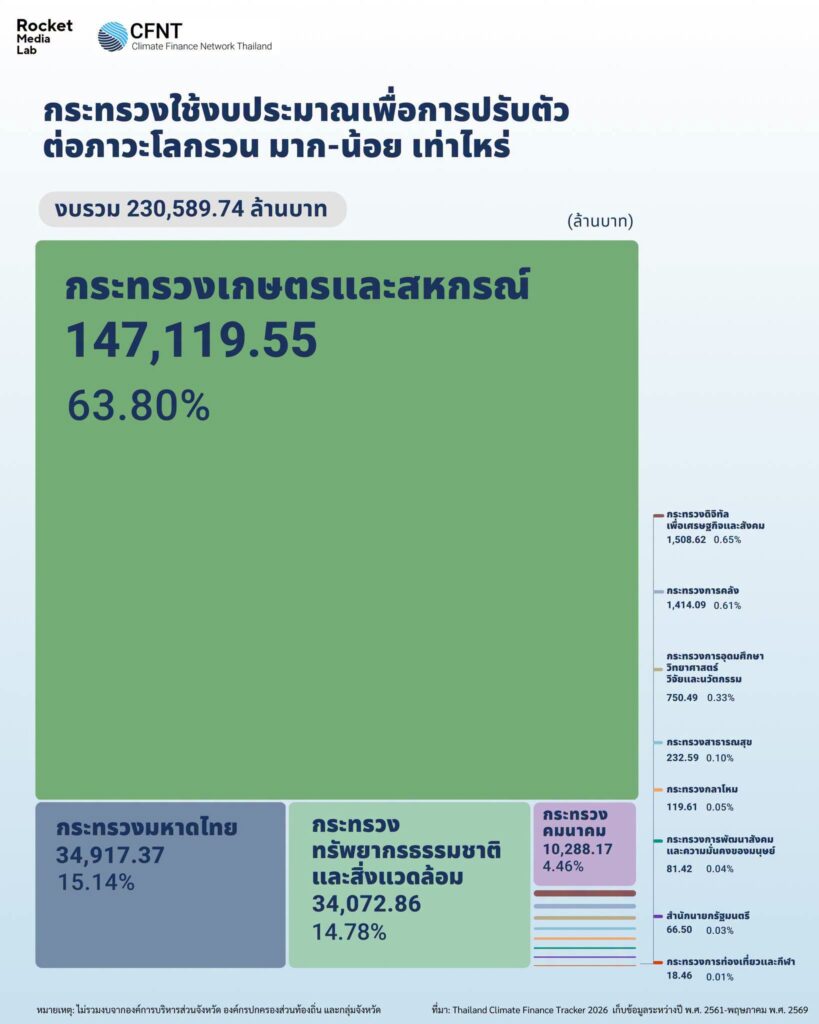
When public-sector climate adaptation finance is classified by ministry, the Ministry of Agriculture and Cooperatives has the largest budget for projects classified as climate adaptation investment, at THB 147,119.55 million, or 63.80%.
Most projects under the Ministry of Agriculture and Cooperatives concern water and sanitation, with a value of THB 133,319.23 million. Ecosystem projects received the smallest allocation, at THB 2.60 million across six projects.s
The Ministry of Interior ranked second, with a budget of THB 34,917.37 million, or 15.14%. Most projects concerned cities and human settlements, valued at THB 18,631.30 million, followed by water and sanitation at THB 15,633.65 million. Ecosystem projects received the smallest allocation, at THB 9.20 million across four projects.
The Ministry of Natural Resources and Environment had a budget of THB 34,072.86 million, or 14.78%. Most projects concerned food, agriculture and forestry, valued at THB 15,897.80 million. Projects concerning cities and human settlements received the smallest allocation, at THB 15.83 million across five projects.
The Ministry of Transport had a budget of THB 10,288.17 million, or 4.46%. Most projects concerned water and sanitation, valued at THB 4,695.88 million. Infrastructure projects received the smallest allocation, at THB 13.25 million across five projects.
The Ministry of Digital Economy and Society had a budget of THB 1,508.62 million, or 0.65%. Most projects concerned social systems, valued at THB 999.68 million, while the remainder were infrastructure projects valued at THB 508.94 million.
In addition, the Ministry of Finance; Ministry of Higher Education, Science, Research and Innovation; Ministry of Public Health; Ministry of Defence; Ministry of Social Development and Human Security; Office of the Prime Minister; and Ministry of Tourism and Sports had combined budgets of THB 2,683.16 million, or 1.16%.
These data show that budgets classified as climate adaptation investment are concentrated in three principal ministries: the Ministry of Agriculture and Cooperatives, the Ministry of Interior, and the Ministry of Natural Resources and Environment.
The Ministry of Agriculture and Cooperatives and the Ministry of Natural Resources and Environment both have direct mandates relating to natural resources, agriculture and the environment. They therefore account for a high share of projects and budgets classified as climate adaptation investment.
The Ministry of Interior, which oversees local administrative organisations, also ranks among the leading government agencies for water-management budgets, particularly those aimed at preventing and addressing floods. Part of this budget is channelled to local administrative organisations across the country, making the Ministry of Interior another ministry with a high level of climate adaptation funding.
For more information on the Thailand Climate Finance Tracker 2026, visit: https://climatefinancethai.com/th/tracker-th/adaptation-th/