
Thailand has announced a target of achieving net-zero greenhouse gas emissions by 2050 under its NDC 3.0, presented to the international community on 19 November 2025 at COP30 in Brazil.
To reach that goal, Thailand has also set an interim target: by 2035, net greenhouse gas emissions must fall to 152 million tonnes of carbon dioxide equivalent, a 47% reduction from 2019 levels.
Meeting this target will require measures across both the public and private sectors, backed by the finance needed to put them into practice.
Rocket Media Lab and Climate Finance Network Thailand (CFNT) invite you to explore investment in greenhouse gas mitigation, or climate mitigation finance, across Thailand’s provinces. This analysis draws on the Thailand Climate Finance Tracker 2026, which tracks investment in two areas: greenhouse gas mitigation and adaptation to climate change. How much has Thailand invested in mitigation? Where has the money gone, and which agencies have spent it?
How much climate mitigation finance has been invested across Thailand?
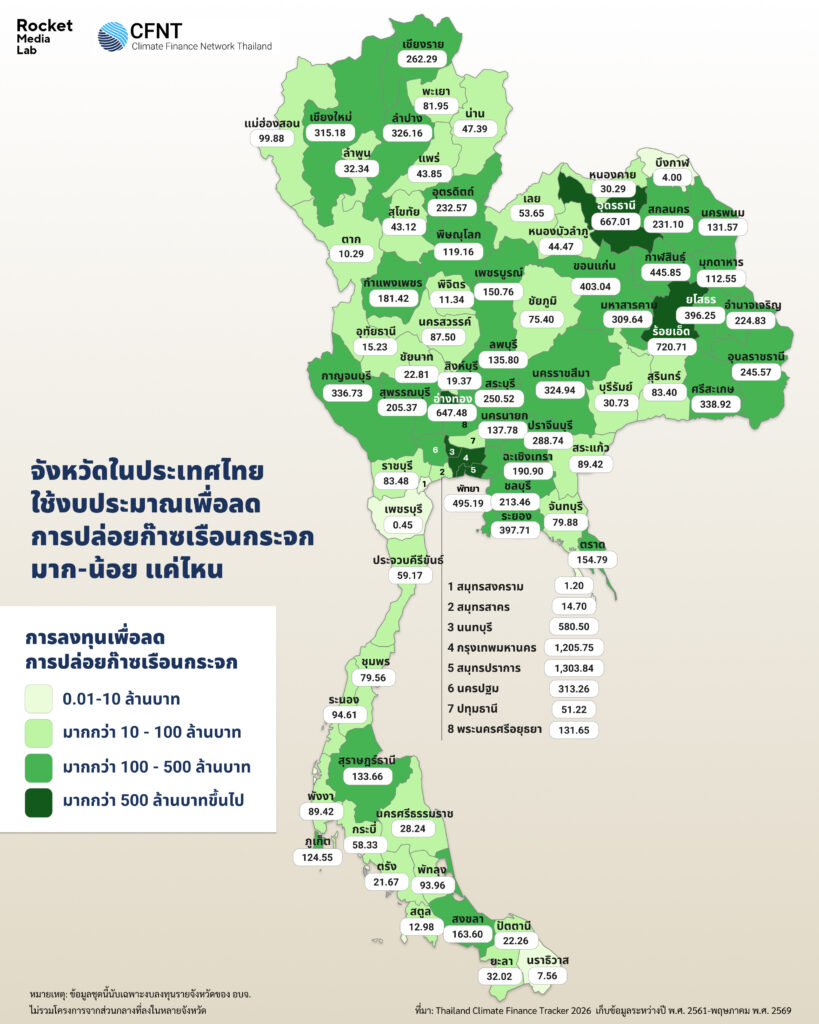
Data from the Thailand Climate Finance Tracker 2026, compiled from sustainability reports and publicly disclosed information, show that between 2018 and May 2026, Thai public-sector agencies invested a total of THB 287,317.54 million in climate mitigation across 3,327 projects. Of these, 809 projects, worth THB 15,307.93 million, were funded through the budgets of provincial administrative organisations and other local government bodies.
When these local investments are broken down by area, the five largest are:
- Samut Prakan: THB 1,303.84 million, or 8.52%
- Bangkok: THB 1,205.75 million, or 7.88%
- Roi Et: THB 720.71 million, or 4.71%
- Udon Thani: THB 667.01 million, or 4.36%
- Ang Thong: THB 647.48 million, or 4.23%
The five provinces with the smallest budgets for climate mitigation finance are Phetchaburi, Samut Songkhram, Bueng Kan, Narathiwat and Tak, in that order.
Samut Prakan has eight projects in total. These include THB 948.40 million in food, agriculture and forestry; THB 327.08 million in energy; THB 27.86 million in buildings and infrastructure; and THB 0.50 million in waste. In Bangkok, THB 788.47 million goes to water and sanitation management projects, while THB 417.28 million goes to waste projects.
Ang Thong has the largest number of projects, at 63. Many fall under buildings and infrastructure, which accounts for THB 643.32 million. Most are road-safety projects involving the installation of solar-powered street lighting. These are followed by water and sanitation management at THB 1.70 million, energy at THB 1.50 million, and food, agriculture and forestry at THB 0.96 million.
Six areas have budgets exceeding THB 500 million: Samut Prakan, Bangkok, Roi Et, Udon Thani, Ang Thong and Nonthaburi. At the other end of the scale, Phetchaburi, Samut Songkhram, Bueng Kan and Narathiwat each have budgets below THB 10 million. Phetchaburi’s budget is just THB 0.45 million.
A comparison with climate adaptation finance shows that Bangkok and Samut Prakan also rank near the top for adaptation investment. They are the only two provinces with mitigation investments exceeding THB 1 billion.
Which sectors receive the most climate mitigation finance?
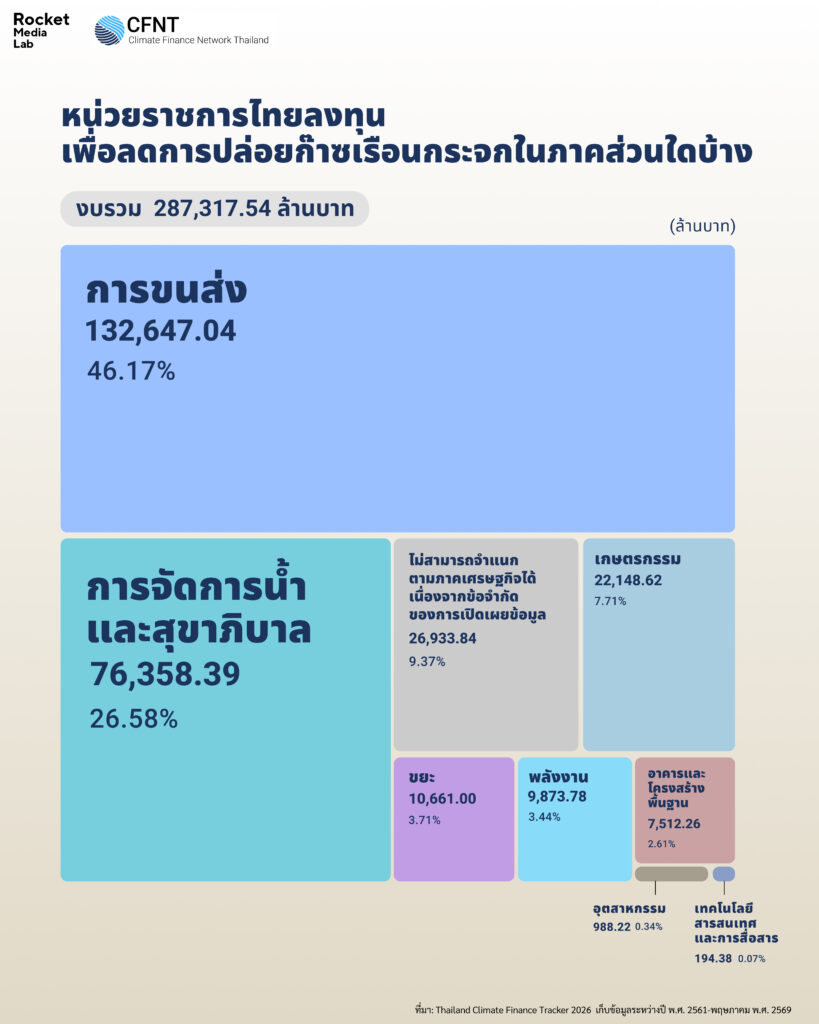
Classifying public-sector climate mitigation investment by economic sector gives the following breakdown:
- Transport: THB 132,647.04 million, or 46.17%
- Water and sanitation management: THB 76,358.39 million, or 26.58%
- Food, agriculture and forestry: THB 22,148.62 million, or 7.71%
- Waste: THB 10,661.00 million, or 3.71%
- Energy: THB 9,873.78 million, or 3.44%
- Buildings and infrastructure: THB 7,512.26 million, or 2.61%
- Industry: THB 988.22 million, or 0.34%
- Information and communications technology: THB 194.38 million, or 0.07%
- Projects that cannot be classified by economic sector because of limitations in publicly disclosed information: THB 26,933.84 million, or 9.37%
Transport receives the largest public-sector budget: THB 132,647.04 million, or 46.17% of the stated total budget of THB 287,317.54. At the provincial level, the largest transport investment is in Songkhla, at THB 45 million, followed by Kanchanaburi at THB 32 million. By ministry, the Ministry of Transport has the largest transport budget, at THB 111,724.44 million.
Water and sanitation management follows at THB 76,358.39 million, or 26.58%. At the local level, Bangkok has the largest investment in this sector, at THB 788.47 million, followed by Pattaya at THB 405.30 million. By ministry, the Ministry of Natural Resources and Environment has the largest budget, at THB 48,256.54 million.
Next are projects that cannot be classified by economic sector because of limitations in publicly disclosed information. They account for THB 26,933.84 million, or 9.37%. At the provincial level, Ranong has the largest amount in this category, at THB 19.62 million, followed by Nakhon Pathom at THB 1 million. By ministry, the Ministry of Natural Resources and Environment accounts for the largest amount, at THB 26,596.19 million.
Food, agriculture and forestry receives THB 22,148.62 million, or 7.71%. At the provincial level, Samut Prakan has the largest investment in this sector, at THB 948.40 million, followed by Yasothon at THB 102.51 million. By ministry, the Ministry of Natural Resources and Environment again accounts for the largest amount, at THB 14,715.74 million.
The remaining five sectors—waste, energy, buildings and infrastructure, industry, and information and communications technology—receive a combined THB 29,229.64 million, or 10.17%.
The contrast with climate adaptation finance is revealing. Adaptation investment is largest in water and sanitation management, at THB 167,869.73 million, while mitigation investment is largest in transport, at THB 132,647.04 million. Nevertheless, water and sanitation management remains the second-largest category of mitigation investment.
Taken together, these figures show that Thailand spends more on water and sanitation management than on any other category of projects related to climate change. Yet the country continues to face drought in the hot season and flooding in the rainy season, with floods in particular becoming more severe year after year. This may suggest that some investments do not address adaptation needs or climate impacts where they matter most. Gray infrastructure serving a single purpose—such as a reservoir or dam—may ultimately become a form of “maladaptation”, making the consequences of climate change harder, rather than easier, to manage.
How much climate mitigation finance is spent through each ministry?
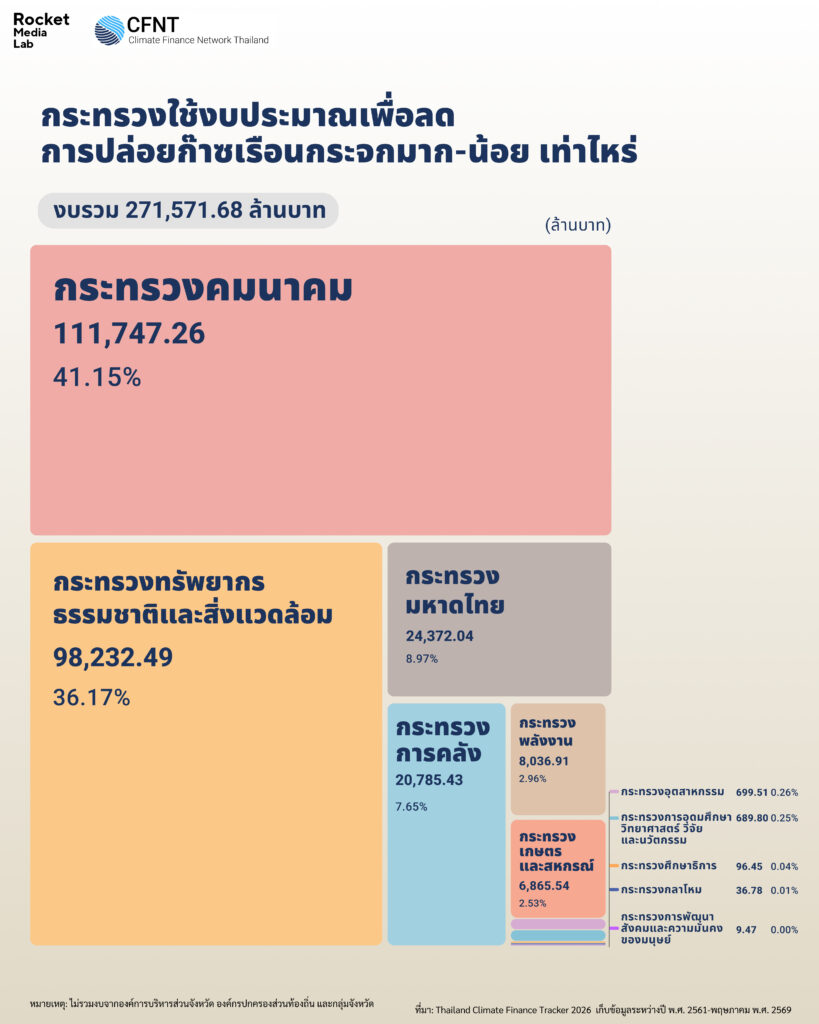
Breaking down public-sector climate mitigation investment by ministry shows that the Ministry of Transport has the largest budget, at THB 111,747.26 million, or 41.15%. Almost all of it—THB 111,724.44 million—goes to transport projects. The remaining THB 22.82 million goes to water and sanitation management.
The Ministry of Natural Resources and Environment follows with THB 98,232.49 million, or 36.17%. Its largest allocation is to water and sanitation management, at THB 48,256.54 million. Among the eight types of projects described, energy receives the smallest allocation, at THB 3 million.
The Ministry of Interior has THB 24,372.04 million, or 8.97%. Most goes to water and sanitation management, at THB 23,818.86 million, followed by waste at THB 531.26 million and energy at THB 21.92 million.
The Ministry of Finance has THB 20,785.43 million, or 7.65%. Most is allocated to transport, at THB 20,754.51 million, followed by buildings and infrastructure at THB 18 million and food, agriculture and forestry at THB 12.92 million.
Six other ministries—the Ministry of Agriculture and Cooperatives; Ministry of Industry; Ministry of Higher Education, Science, Research and Innovation; Ministry of Education; Ministry of Defence; and Ministry of Social Development and Human Security—have a combined budget of THB 16,434.45 million, or 6.05%.
These figures show that budgets classified as climate mitigation finance are concentrated in two ministries: Transport and Natural Resources and Environment. Together, they account for a stated 77.32% of the total.
Climate adaptation finance presents a different picture. The Ministry of Agriculture and Cooperatives alone accounts for 63.80% of the total adaptation budget, while the Ministry of Transport receives the largest share of the mitigation budget. This difference reflects the emphasis Thailand’s mitigation efforts place on transport. At the same time, however, the energy sector is responsible for the largest share of the country’s greenhouse gas emissions, at 67%, and transport is part of that sector.
Climate adaptation and mitigation investment across Thailand’s provinces
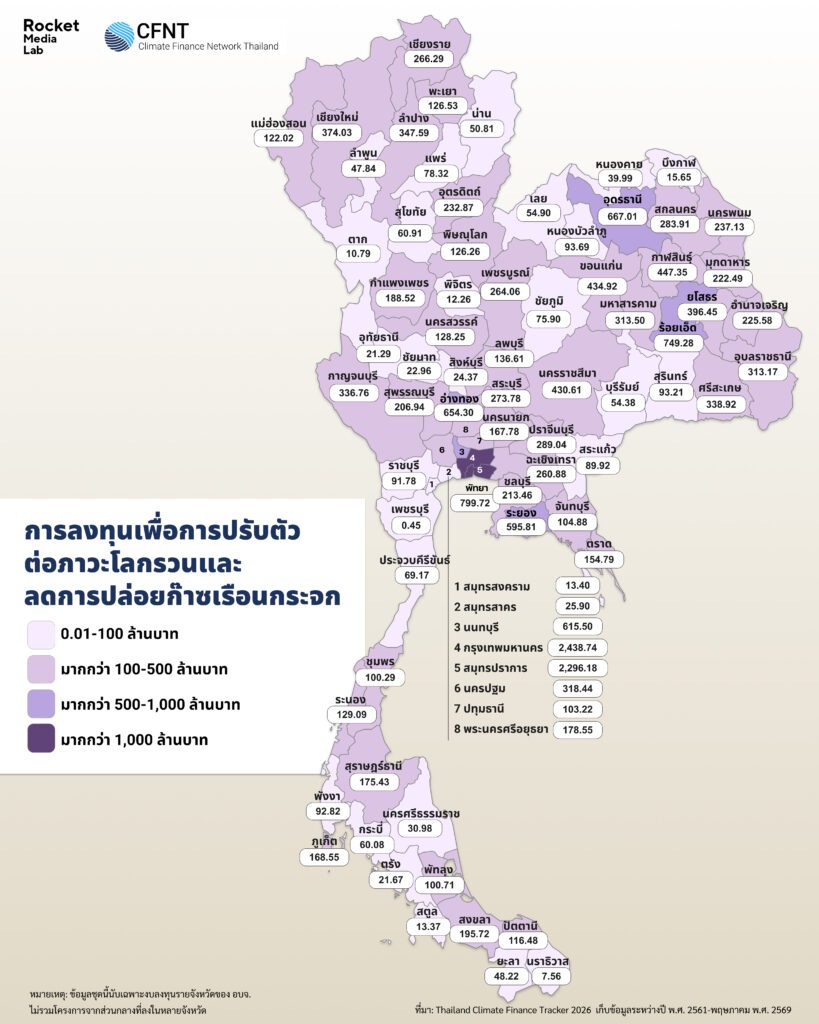
Combining climate adaptation and mitigation investment, then breaking the figures down by area, shows which provinces and administrative areas have received the most investment to address climate change. The top ten are:
- Bangkok: THB 2,438.74 million, or 12.39%
- Samut Prakan: THB 2,296.18 million, or 11.66%
- Pattaya: THB 799.72 million, or 4.06%
- Roi Et: THB 749.28 million, or 3.81%
- Udon Thani: THB 667.01 million, or 3.39%
- Ang Thong: THB 654.30 million, or 3.32%
- Nonthaburi: THB 615.50 million, or 3.13%
- Rayong: THB 595.81 million, or 3.03%
- Kalasin: THB 447.35 million, or 2.27%
- Khon Kaen: THB 434.92 million, or 2.21%
Bangkok and Samut Prakan receive the most investment to address climate change. They also rank first and second in both adaptation and mitigation investment. Both have combined investment exceeding THB 2 billion.
Phetchaburi receives the least, at just THB 0.45 million. It is the only province with investment classified as climate-related below THB 1 million. Another 28 provinces have such budgets below THB 100 million.
Overall, major economic and social centres—Bangkok, Samut Prakan, Pattaya, Nonthaburi, Rayong and Khon Kaen—receive more investment to address climate change than other areas. These places may face greater risks and vulnerabilities, particularly in terms of the economic and social impacts of climate change. That may help explain why their climate-related investment budgets are higher than those elsewhere in the country.