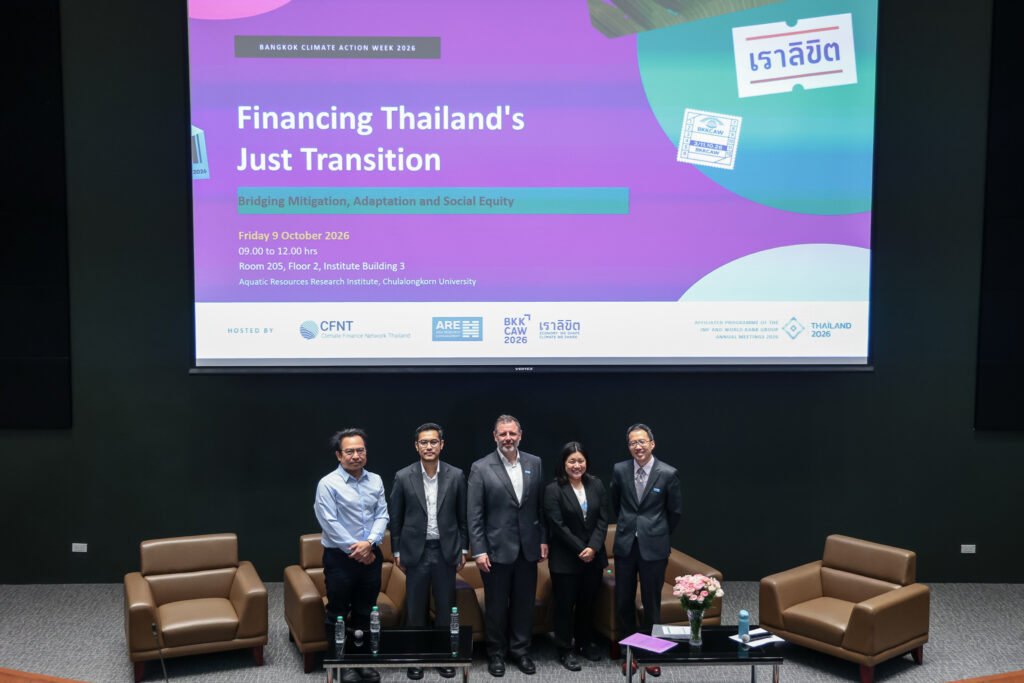
Thailand’s NDC 3.0 sets a target of net-zero greenhouse gas emissions by 2050. That gives the country less than 25 years to transform its economic and social systems. Without careful attention to the idea of a just transition, this major shift could leave many people behind.
Against this backdrop, Climate Finance Network Thailand (CFNT) and Asia Research & Engagement (ARE) convened the discussion “Financing Thailand’s Just Transition: Bridging Mitigation, Adaptation and Social Equity.” The session brought together Thai and international experts to exchange perspectives and experience.
Speakers
- Thanida Lawseriwanich, Head of Research, Climate Finance Network Thailand
- Ben McCarron, Founder and CEO, Asia Research & Engagement (ARE) Group
- Kate Hughes, Senior Climate Change Specialist, ADB Climate Change and Sustainable Development Department
- Narut Boakajorn, Chief Development Officer, Impact Electrons Siam Company Limited
- Tara Buakamsri, Director, Climate Connectors programme
- Moderator: Wai-Shin Chan, Director of Research, Asia Research & Engagement (ARE) Group
What does a just transition look like in Thailand and Southeast Asia? How do the private and financial sectors view their role, and what must they do to ensure that development supports the long-term well-being of communities? This summary brings together the key messages from the discussion.
More finance but people still left behind
“Budget allocation is critical for a just transition. Building the capacity of public agencies while learning from community-led solutions can help direct funding to the people who need it most.” — Thanida Lawseriwanich, Head of Research, Climate Finance Network Thailand
Thanida described Thailand’s climate-finance landscape as moderate. The Thailand Climate Finance Tracker 2026 shows that climate investment has continued to grow: from 2018 to May 2025, Thailand accumulated around THB 2 trillion in mitigation finance and around THB 280 billion in adaptation finance.
Yet rising adaptation finance does not necessarily mean that it is effective. CFNT finds that less than 4% of tracked adaptation finance reaches children, older persons, women and persons with disabilities. Given Thailand’s climate vulnerability, this is a small and concerning share.
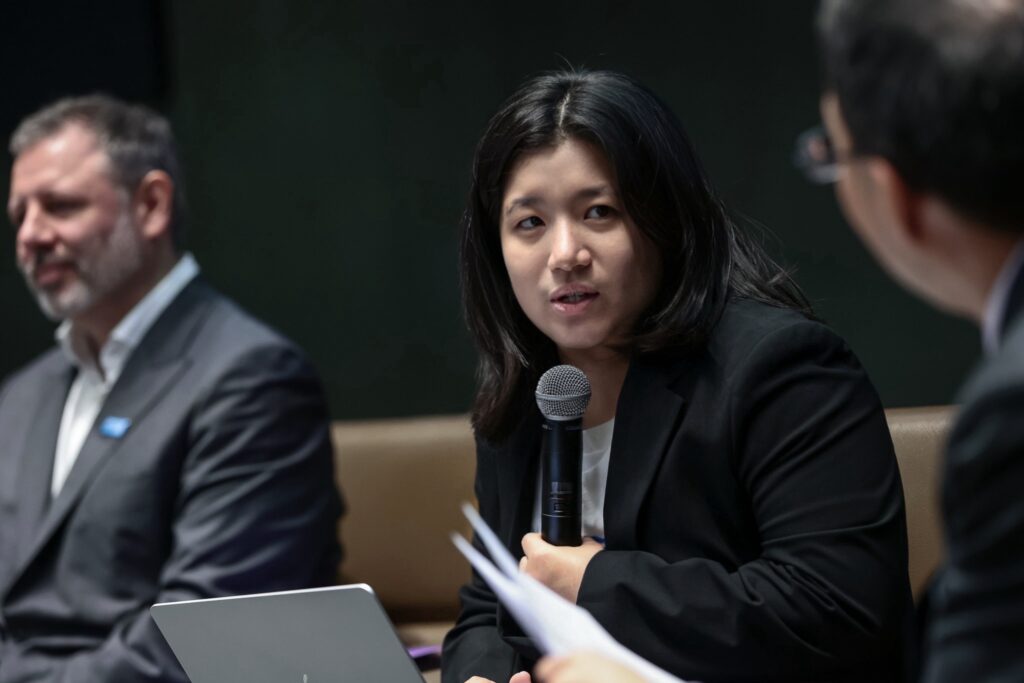
Thanida argued that just-transition finance needs to work in two directions. From the top down, public officials need stronger capacity to identify adaptation objectives, allocate budgets more effectively and give greater attention to vulnerable groups. From the bottom up, communities should be able to develop and bring forward locally appropriate responses.
She gave the example of a community in China responding to extreme heat: residents identified that wheelchair users could not use their wheelchairs safely in high temperatures, developed a response and brought it to local government. Thailand, she suggested, should create channels through which communities can bring such proposals to local authorities.
Thanida also stressed the importance of effective adaptation investment to avoid maladaptation: interventions that do not solve a problem, but instead increase, shift or transform risks within the same place or elsewhere. She proposed four actions for financial institutions:
- Tag loans clearly by both purpose and location, because adaptation is highly context-specific and an intervention that works in one place may not work in another.
- Incorporate maladaptation risk into credit due diligence.
- Use existing Thailand Taxonomy principles, including Do No Significant Harm and Minimum Social Safeguards, to screen project risks.
- Monitor projects over time, because maladaptation impacts often emerge after construction or implementation.
How companies and communities can thrive together
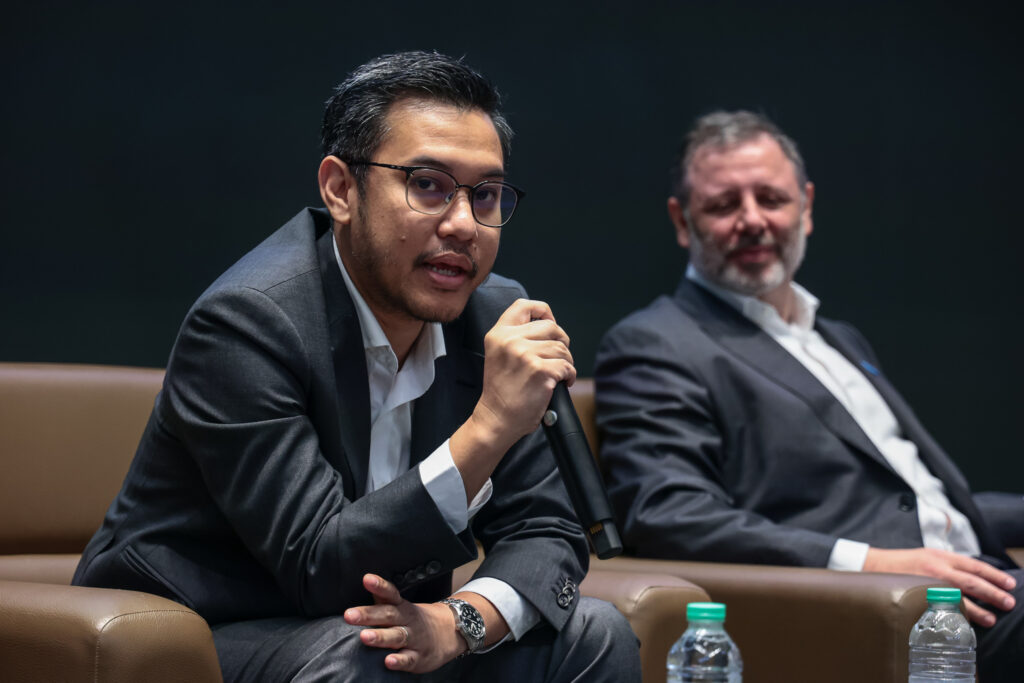
“As a developer, our role is not only to minimise harm, but also to create tangible benefits for the community. That starts with listening and trying to understand people, honouring our commitments and implementing them properly. Ultimately, it comes down to two things: trust and respect.” — Narut Boakajorn, Chief Development Officer, Impact Electrons Siam Company Limited
Narut assessed Thailand’s current position at around five out of ten. Rules, regulations and environmental and social safeguards already exist, including among Thai financial institutions. The central challenge, he said, is serious and consistent implementation.
He described the Monsoon Wind project, a wind-power project in a remote part of southern Lao PDR. The project was designed around the intention to support community development alongside its own growth. Engagement included stakeholder consultations and focus-group discussions with women and vulnerable groups, which informed a community development plan, a livelihood restoration plan and a grievance mechanism.
The project has 133 wind turbines across an area encompassing 29 villages with a population of around 16,000 people. By locating facilities outside villages, the project achieved zero resettlement.
The same principles were applied to contractors through a “Permit to Start Work” system. Before a contractor can begin construction in a particular area, it must demonstrate that all relevant environmental and social requirements have been addressed. Otherwise, work cannot begin.
Narut added that lenders can reinforce a just transition through their oversight. At Monsoon Wind, ADB monitored environmental and social commitments during construction and operation. Lenders can require corrective action and, in cases of serious non-compliance, may suspend loan disbursement.

Reframing projects and matching with finance
“For a just transition, social considerations cannot simply follow an investment decision and be treated only as risks to mitigate. By identifying socioeconomic risks and needs early, we can integrate them into investment design and identify complementary support, such as skills training, education and social protection, that may need to come first.” — Kate Hughes, Senior Climate Change Specialist, ADB Climate Change and Sustainable Development Department
Kate Hughes explained that ADB has strengthened its approach to environmental and social risk management, covering labour conditions, community safety, land acquisition and stakeholder engagement, alongside poverty and social analysis.
For ADB, however, a just transition is not only about mitigating social risks after an investment decision has been made. It is an enabling agenda for climate action. Upstream technical assistance can identify socioeconomic risks, impacts and complementary investments early—such as skills development, education reform, social protection and other social investments. In some cases, these investments need to come first to enable climate investment to succeed.
Hughes also argued for moving beyond a project-by-project approach. Integrated planning can clarify which parts of a transition may be financed by the private sector, which require public borrowing or public budgets, and which need grants or highly concessional finance. It can then match tools—including grants, just-transition bonds and guarantees—to the outcomes sought.
On maladaptation, she noted that awareness has increased substantially over the past decade. ADB’s climate risk and adaptation assessments consider hazards, vulnerabilities, adaptation measures and the possibility that an intervention may create unintended impacts or transfer risks to other communities or sectors. Key challenges remain: defining the boundary of responsibility while keeping investments bankable, and ensuring that risk assessments influence real decisions and project design. Maladaptation is often easiest to identify in hindsight, so anticipatory risk assessment needs to improve.
Asking a different question for shared and fair growth
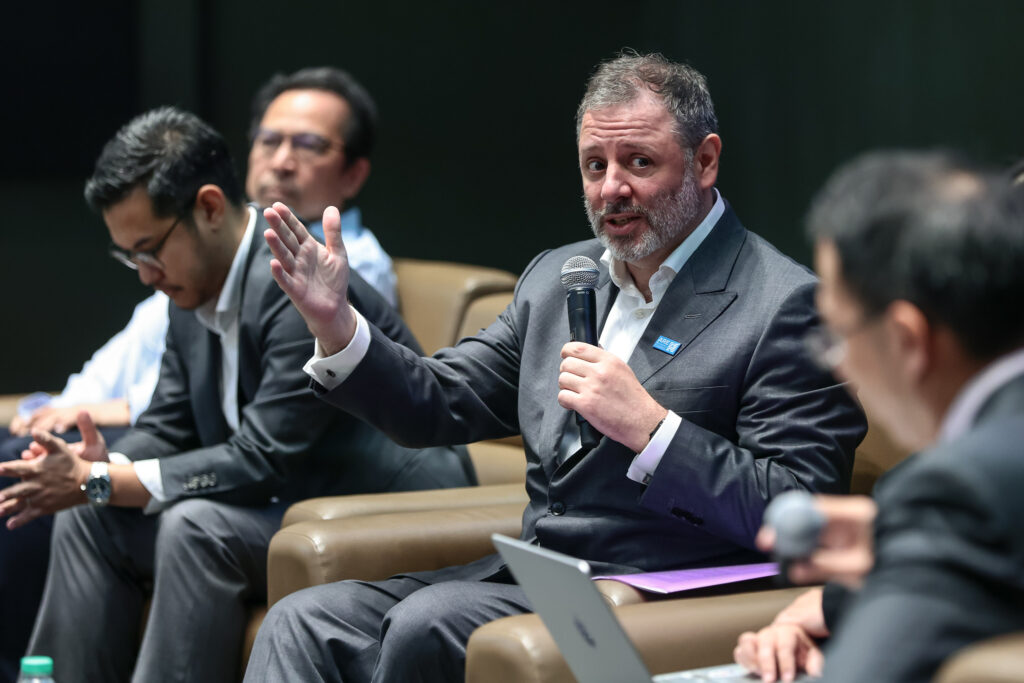
“Climate finance for a just transition should not stop at the minimum standard of doing no harm. The bigger question is whether investment helps communities thrive and benefit from the resources around them.” — Ben McCarron, Founder and CEO, Asia Research & Engagement (ARE) Group
Ben McCarron saw positive momentum in climate finance, but said that today’s investment remains far below what is needed for renewable-energy deployment and climate adaptation in Thailand and across Southeast Asia.
He contrasted two questions. One asks what minimum standard an external private-sector actor should meet to use a resource for profit. The other asks how a community can use that resource to thrive and support its own sustainable development. Private investors are often primarily return-oriented and therefore tend to start from a minimum “do no harm” standard. But conflict with communities can delay projects and consume management time. McCarron encouraged developers and investors to begin instead with the question of how the community can benefit and thrive.
He also raised the need for communities to have their own local development plans, capacity and stable funding. Investors may enter a community at a particular moment, but are unlikely to remain indefinitely. Public funding that reaches communities can therefore help sustain local development over time.
McCarron proposed widening the meaning of a just transition to include animals—wildlife, companion animals and farm animals—which are affected by climate change but cannot make their own voices heard in policy or project design.
He concluded that finance and investors cannot achieve a just transition on their own. Southeast Asia’s energy transition remains slower than the economics of renewable energy would support because policy barriers continue to favour fossil fuels. Policy reform is needed to create a level playing field for cleaner, cheaper and more energy-secure options.
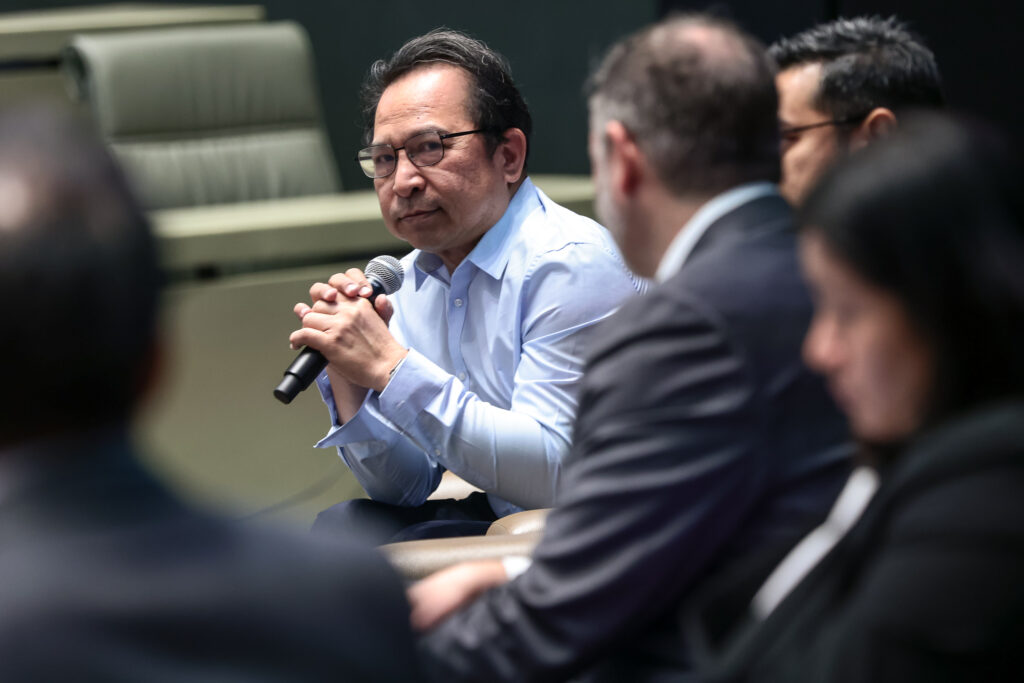
Communities at the centre of a just transition
“A project can carry a green label without being a just project. Climate finance must be judged by where the money goes, who benefits, and whether communities have a meaningful voice from the beginning.” — Tara Buakamsri, Director, Climate Connectors programme
Tara Buakamsri argued that the central question is what Thailand’s climate finance is funding and whether it produces fair outcomes. A project with a climate objective is not necessarily just for communities and people.
Drawing on his experience, he noted that some large projects in Thailand give too little weight to public consultation, relying on short consultation periods, incomplete documentation and limited follow-up after approval. Consultation should be improved so that it is not treated merely as a legal formality.
He identified two key challenges for Thailand’s just transition. First, the power system limits opportunities for people to become prosumers—both electricity producers and users—and lacks sufficient investment in modernising the grid to accommodate renewable energy. Clean-energy investment needs to go hand in hand with grid investment.
Second, adaptation finance remains largely government-led and heavily concentrated in water management, while the public agencies responsible for water management do not yet coordinate effectively. Adaptation should improve resilience and adaptive capacity for everyone, not only protect economic value.
Tara concluded that communities, as key stakeholders, should be central to the design of adaptation plans. They should also work alongside experts, academic institutions or independent advisers that can help develop and scrutinise projects so that they respond to the needs of all parties.
Across the discussion, speakers agreed that a just transition is an opportunity to address environmental challenges while reducing social inequality. Meaningful participation by communities in shaping and developing their own places, alongside all relevant sectors, is essential.