
The devastating floods of 2011, the recurring cycle of El Niño and La Niña, and growing concerns over Bangkok’s vulnerability to rising sea levels all point to the same reality: the world has changed, and Thailand is already feeling the consequences.
The question is: how Thailand is preparing for the uncertainty that lies ahead?
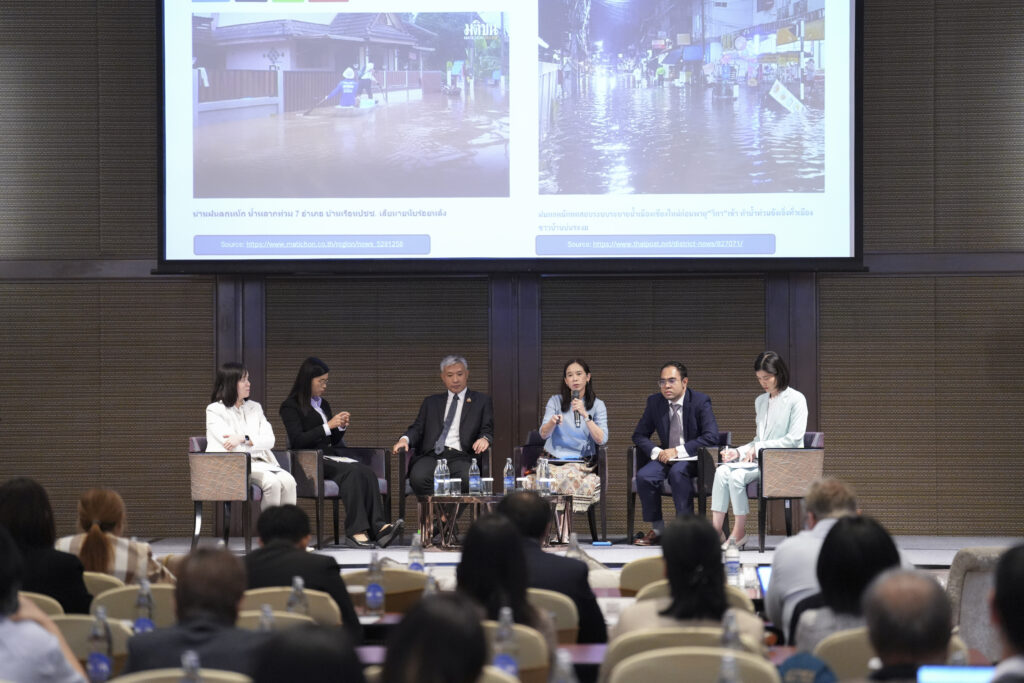
This question was at the heart of the panel discussion, “From Chaos to Resilience: Co-Designing Climate Adaptive Future,” held during the launch of the 2025 Climate Finance Tracker: Uncovering Thailand’s Flows. Organized by the Climate Finance Network Thailand (CFNT), the event brought together experts from various sectors to discuss Thailand’s future in adapting to an increasingly volatile climate.
What risks does climate change pose to Thailand? How severe are climate-related disasters? How prepared are we to cope with future climate impacts? And what shifts in thinking are needed to navigate a climate-disrupted world? This article summarizes key insights from the discussion.
Why Data is Matters? – Dr. Kannika Thampanishvong
Dr. Kannika Thampanishvong, Head of Research at the Puey Ungphakorn Institute for Economic Research (PIER) and a contributor to the Thailand Climate Finance Tracker, began by highlighting the growing impacts of climate change on Thailand.
According to the EM-DAT international disaster database, water-related disasters have been Thailand’s most significant climate risk between 2000 and 2022. During this period, the country experienced more than 60 major water-related disasters, resulting in at least 2,457 fatalities and economic losses equivalent to approximately 0.57% of GDP. Other climate-related hazards, including droughts, storms, and earthquakes, have also affected the country.
“Global temperatures have increased by only around one degree Celsius so far, yet Thailand is already experiencing severe disasters. If temperatures rise by two to four degrees, how much more frequent and intense will these extreme events become?” Dr. Kannika asked.

The Thailand Climate Finance Tracker seeks to address critical information gaps surrounding climate adaptation and resilience. One key finding from the research is that Thailand invested approximately THB 148 billion in climate adaptation between 2020 and 2024. However, estimates from the United Nations Economic and Social Commission for Asia and the Pacific (UNESCAP) suggest that the country may require as much as THB 16 trillion to effectively adapt to climate change and strengthen resilience.
The study also found that 98% of climate adaptation financing currently comes from the public sector.
While these figures highlight the substantial financing gap Thailand still faces, Dr. Kannika emphasized that reliable data is also a powerful tool for progress. Better information enables broader participation from different stakeholders and supports the development of more effective public policies.
“Climate adaptation is an ongoing process. It requires continuous monitoring, evaluation, and revision. To do that effectively, we need comprehensive data—from inputs and outputs to outcomes and impacts—in order to understand whether policies are truly delivering results,” she concluded.
Climate Change Is Water Challenge – Dr. Sitang Pilailar
Dr. Sitang Pilailar, a water management specialist from the Faculty of Engineering at Kasetsart University, noted that climate change is making floods around the world both more severe and less predictable.
She cited the example of severe flooding in Texas, where even advanced early-warning systems were unable to prevent significant loss of life after rainfall exceeded 500 millimeters within just three to four hours. The speed and intensity of the event overwhelmed evacuation efforts, leading to at least 137 fatalities.

Thailand faces similar challenges. According to data from the Centre for Research on the Epidemiology of Disasters (CRED), covering the period from 1900 to 2020, water-related disasters have consistently been the country’s most frequent natural hazard, with both frequency and severity increasing over the past two decades.
At the same time, Thailand has made progress in water management. Data from the Department of Disaster Prevention and Mitigation between 2004 and 2023 indicate that overall flood-related damages have generally declined, although certain sectors—particularly agriculture, which often serves as a flood retention area—continue to bear significant impacts.
Dr. Sitang explained that water has always been a central policy challenge for Thailand, and the country’s water management approach has evolved over time. Earlier strategies focused heavily on large dams for water storage and hydropower generation. More recently, greater attention has been given to climate adaptation measures, including technological innovation and improved disaster warning systems under Thailand’s 13th National Economic and Social Development Plan.
However, an important question remains: have these policies truly effective at managing water risks?
To illustrate the challenge, Dr. Sitang pointed to the dramatic increase in water and disaster management budgets following the catastrophic floods of 2011. Approximately THB 5.9 billion was invested in riverbank protection structures spanning 49,000 kilometers and flood barriers covering 4,027 kilometers—equivalent to roughly one-tenth of Thailand’s total river network. Yet many of these structures ultimately failed when confronted with real flood conditions.
Beyond flooding, Thailand continues to face a range of water-related challenges. The country loses more than 800 million cubic meters of treated water annually due to leaks in distribution systems—equivalent to the storage capacity of three Kiu Lom Dams. Other concerns include drought, drinking water quality, and contamination in the Kok River, which highlights the increasingly transboundary nature of water-related risks.
“When it comes to water management, it appears that the approaches we have relied on for the past 120 years are no longer sufficient to address today’s challenges,” Dr. Sitangsu concluded. “What we need now is vision, integration, and the courage to embrace change.”
From Grey to Green and Blue Infrastructure – Dr. Naim Laeni
“The most disaster-resilient system is nature itself. Mangrove forests provide the most effective protection against coastal erosion and storm surges. Rivers are among the most efficient systems for retaining and regulating water. Yet many infrastructure investments continue to undermine these natural systems.” Dr. Naim Laeni
Dr. Naim Laeni, Urban Development and Design Specialist at Thammasat University, began by arguing that Thailand’s approach to flood management has historically relied heavily on engineered infrastructure. However, rather than solving the problem, this approach has often created what he described as a “vicious cycle” of water management.
The first challenge is that investments in flood protection infrastructure tend to trigger an endless cycle of additional construction. Seawalls become longer, embankments become higher, and each new intervention creates pressure for further expansion.
The second challenge is that efforts to secure water resources through large-scale reservoirs and dams have gradually shifted attention away from natural water retention systems. As a result, wetlands, floodplains, and other natural water-storage areas have been neglected or degraded.
The third challenge is that the more one area is protected by flood-control infrastructure, the more vulnerable neighboring areas can become. Flood risks are often displaced rather than eliminated, transferring the burden from one community to another.
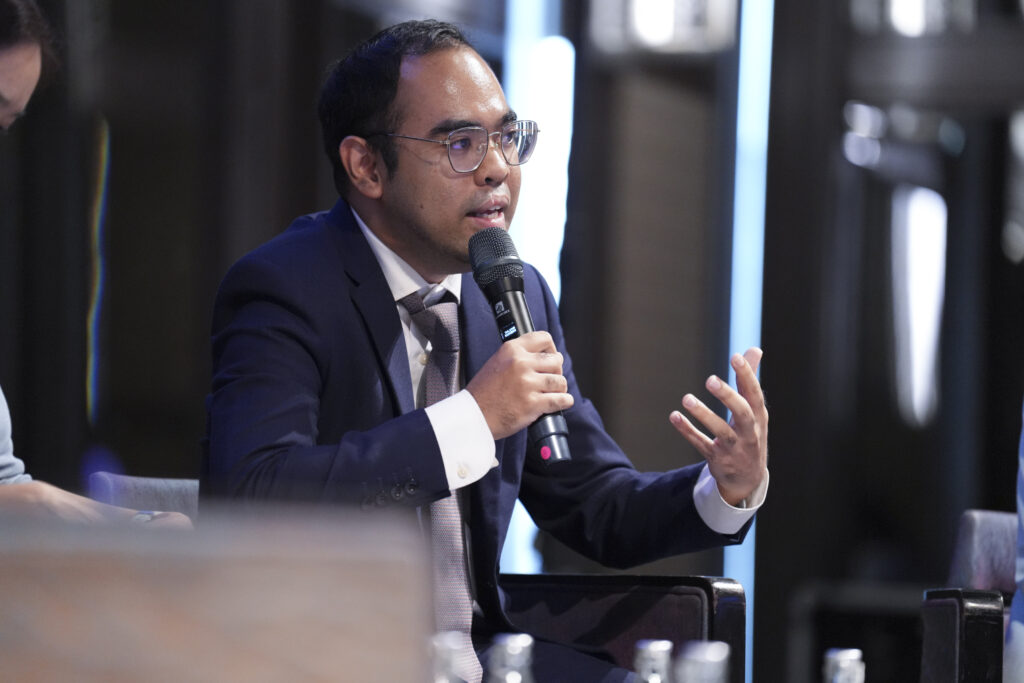
According to Dr. Naim, these challenges highlight the limitations of relying solely on grey infrastructure. Building resilience in an era of climate uncertainty requires a transition toward green and blue infrastructure—approaches that work with natural systems rather than against them. Restoring rivers, wetlands, mangrove forests, and urban green spaces can help reduce disaster risks while simultaneously improving environmental quality and quality of life.
In a climate-disrupted future, resilience will depend not only on stronger engineering but also on a renewed ability to integrate nature into the design of cities and landscapes.
Dr. Naim encouraged Thailand to place greater emphasis on planning and design processes. This means developing a deeper understanding of natural systems, local geography, and the interconnected nature of environmental challenges. It also requires meaningful engagement with local communities and a willingness to question whether additional large-scale infrastructure is always the right solution. After all, every new infrastructure project often comes at the expense of natural systems, which remain the most resilient defense against water-related disasters.
To strengthen Thailand’s water resilience, Dr. Naim proposed three key recommendations.
First, adaptation strategies should be designed with communities rather than for communities. Local residents possess valuable knowledge of their surroundings and are often best positioned to identify practical and context-specific solutions.
Second, Thailand should break down institutional silos in water governance. He proposed a “3+” coordination model, with the Royal Irrigation Department, the Office of the National Water Resources, and the Department of Water Resources serving as core agencies that work closely with other stakeholders, including local governments and community organizations.
Third, water management should increasingly be guided by Nature-based Solutions (NbS). Examples include Thailand’s “Monkey Cheek” flood retention projects, mangrove restoration initiatives, and the protection of wetlands that naturally absorb and regulate water flows.
Dr. Naim also urged policymakers to broaden their understanding of investment beyond financial capital. He highlighted three additional forms of investment that are equally important: investing in collaboration and inclusive participation, investing in environmental and cultural co-benefits, and investing in local communities and private-sector partnerships. Governments, businesses, communities, and financial institutions all have a role to play in building more resilient cities.
“While it may be difficult to assign a monetary value to these processes and natural assets today, I believe that once we truly recognize their value, we will eventually be able to measure the returns they generate for society,” Dr. Naim concluded.
Bangkok’s Journey Toward a More Livable City
Dr. Witoon Apisitpuvakul, Director of the Strategy and Evaluation Department of the Bangkok Metropolitan Administration (BMA), opened his remarks with two numbers.
The first was “1” — a reflection of Bangkok’s consistent ranking among the world’s most popular tourist destinations according to multiple international travel platforms.
The second was “98” — Bangkok’s ranking in the Global Livability Index 2023. While the city may be one of the world’s most visited destinations, it ranked only 98th in terms of livability. For Bangkok’s policymakers, this number became a catalyst for change and a reminder that being a great place to visit does not necessarily make a city a great place to live.

Under Chadchart Sittipunt, Bangkok Governor (2022-2026) Bangkok has embraced the vision of becoming “a livable city for all.” To achieve this goal, the city has integrated its “9 Goods” policy framework with internationally recognized benchmarks, including the United Nations Sustainable Development Goals (SDGs) and World Health Organization recommendations on urban green space. One notable example is the WHO guideline recommending at least nine square meters of green space per person, which has inspired initiatives such as Bangkok’s “15-Minute Park” program.
As a result, Bangkok’s development trajectory has become increasingly aligned with broader sustainability objectives and climate adaptation priorities.
In practical terms, Ms. Woranuch Suaykakaow , Deputy Director of the Environment Department at the Bangkok Metropolitan Administration, emphasized that climate action has become a central priority for the city. This commitment is reflected in Bangkok’s proposed 2026 budget, which allocates THB 19.9 billion—approximately 21.6% of the city’s total budget of THB 92 billion—to climate-related initiatives.
The allocation is divided into three categories:
- THB 13.1 billion (66%) for greenhouse gas mitigation;
- THB 6.3 billion (32%) for climate adaptation; and
- THB 470 million (2%) for climate prevention and resilience-building measures.
Bangkok has also increasingly adopted Nature-based Solutions in urban development. One notable example is the transformation of the former On Nut landfill site into the On Nut Urban Forest Park. Local residents were directly involved in planting trees, creating a stronger sense of community ownership. Today, the area has become a thriving urban forest that provides habitat for more than 30 bird species while supporting the city’s broader 15-Minute Park initiative.
Similarly, a former flood retention area in Bueng Kum District has been redeveloped into the Bangkok Wetland Forest Park, demonstrating how urban spaces can simultaneously serve ecological, recreational, and climate adaptation functions.
The city has also explored innovative financing mechanisms for climate action. These include public-private partnerships for waste-to-energy facilities and incentive schemes that encourage private landowners to contribute land for new green spaces under the 15-Minute Park program. In return, participating landowners receive property tax exemptions for up to seven years—a policy that has received strong interest from the private sector.
Although the road ahead remains long and challenging, the growing public conversation around climate resilience, the availability of better data, and the visible commitment demonstrated by Bangkok offer reasons for optimism. Together, these developments suggest that Thailand’s path toward a more resilient future is becoming clearer—and increasingly within reach.
For more about Thailand Climate Finance Tracker: https://climatefinancethai.com/tracker/adaptation/