
Thailand’s household debt reached 86.7% of GDP at the end of 2025, among the highest ratios in Asia. The Bank of Thailand’s own data show that debt taken on for consumption is rising while debt taken on for income-generating purposes is contracting, the picture of a sector borrowing more to sustain daily life and less to build anything.
The International Energy Agency (IEA) identifies energy as the third-largest household expense globally after food and housing. When residential energy and transport costs are combined, the poorest households spend over 20% of their income on energy. In Southeast Asia, poorer communities face high risk from energy price spikes, as energy can account for a large share of overall spending. Residential electricity is the component most exposed to price volatility, and in Thailand that volatility is built into the system. The Ft, recalculated every four months based on international gas prices, means bills can rise sharply with no warning. When they do, households with no buffer absorb the increase through additional borrowing.
When residential energy and transport costs are combined, the poorest households spend over 20% of their income on energy.
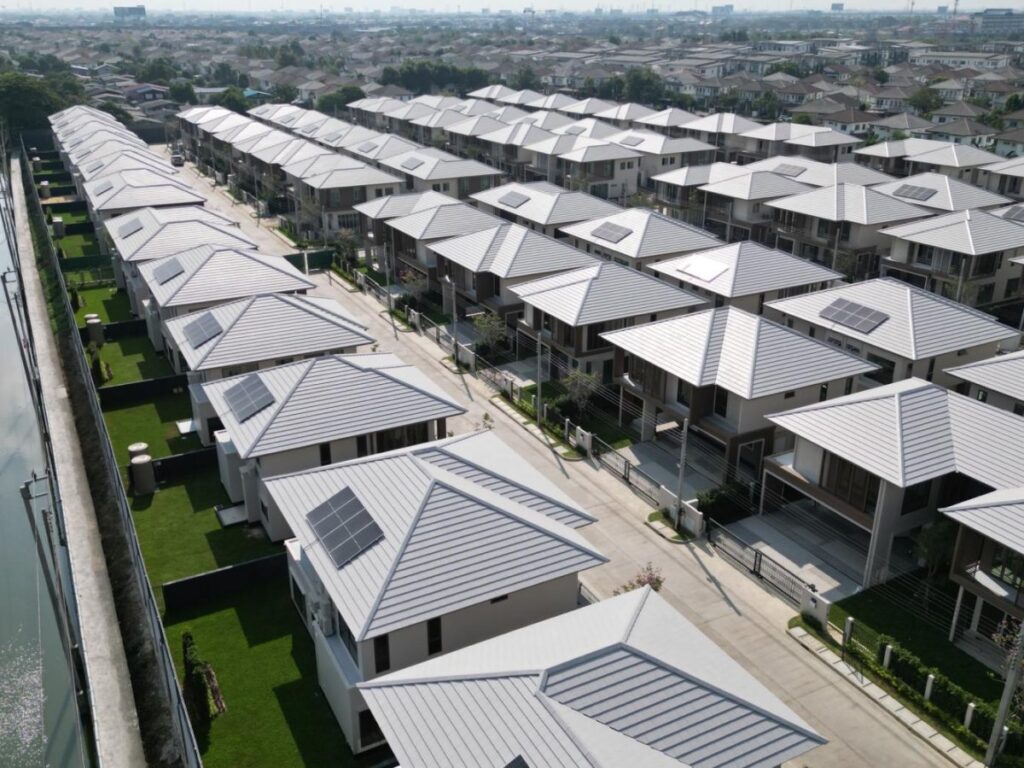
Against that backdrop, consider what a rooftop solar system actually is in financial terms. It is a fixed-cost, yield-generating asset with a productive life of twenty-five years, running costs close to zero, and a return in the form of reduced electricity bills that begins immediately. The obstacle is access to that financing, a problem the financial system created and can fix.
Why the electricity bill matters to this argument
EGAT is currently carrying 35.9 billion baht in accumulated energy costs on behalf of electricity consumers. When the ERC set the May to August 2026 tariff at 3.95 baht per unit, it did so by allowing that balance to remain on EGAT’s books. The alternative would have been 4.59 baht, an 18% increase in a single billing cycle.
In response to rising electricity costs and EGAT debt, the cabinet introduced two major policies: a new three-tier residential tariff structure, under which households that consume more electricity pay higher rates, and an expansion of the rooftop solar buy-back programme to 500 megawatts under 10-year agreements beginning in June 2026. In effect, the government is nudging higher-consuming households toward investing in rooftop solar systems themselves.
However, this policy may rest on a flawed assumption that high electricity consumption always reflects higher income. In reality, some households consume large amounts of electricity because they run medical equipment at home, operate home-based businesses, or support large families. Many of these households may still struggle financially.
More importantly, these policies may do little to help those most burdened by rising electricity costs. The problem is not willingness. It is access to capital.
Who the financial system currently serves
CFNT’s 2024 research found that Thai banks classify solar installations as home loans requiring property collateral, effectively excluding renters, young workers, and asset-light households.[7] The Ft on their bill is identical to their property-owning neighbours, but the financial system offers them no equivalent route to the asset that would reduce that exposure.
The households with Thailand’s highest debt burdens are the same ones the IEA identifies as spending a disproportionate share of income on energy, with the least cushion against future Ft increases, and who would benefit most from converting a recurring variable outflow into a fixed productive asset. The financial system as currently designed serves them last.
Reaching them means different solutions for different groups: financing terms for low-income homeowners, and structural fixes for renters and condo tenants who do not own the roof above them.
Five practical steps that do not require new money
First, extending loan tenors from five to seven years to fifteen or twenty years, matched to the system’s productive life, would bring monthly repayments within the range of electricity savings for many households. This requires no government spending, only product design.
Second, a green loan guarantee facility through which a government agency backstops unsecured solar lending risk would extend access to borrowers without property collateral. The Bank of Thailand has the tools to facilitate this, including by reducing risk weights on renewable energy lending from 100% to 50%, a step CFNT and Fair Finance Thailand formally proposed in their January 2026 joint whitepaper.
Third, the solar system itself should be recognized as loan collateral, similar to vehicle financing, rather than mortgage top-ups.
Fourth, on-bill financing through MEA and PEA would allow households to repay solar investments directly through electricity bills, using existing payment histories as a credit profile. A household is not taking on new debt, converting a variable recurring cost into a finite asset-backed one.
Fifth, a phased commitment to narrow the gap between the 2.20 baht buy-back rate and the 3.95 baht retail rate raises the return on every residential installation at no fiscal cost to the government, and strengthens the asset-as-collateral case for lenders.
Conclusion
Thailand’s household debt problem and Thailand’s solar opportunity are not separate conversations. They are the same conversation from different angles. The households most burdened by debt are the same ones most exposed to energy price volatility and least able to access the asset that would reduce it.
What remains is the institutional decision to treat a solar panel as what it actually is: not a renovation, not a green gesture, but a practical financial tool for households that have spent long enough paying for energy they will never own.